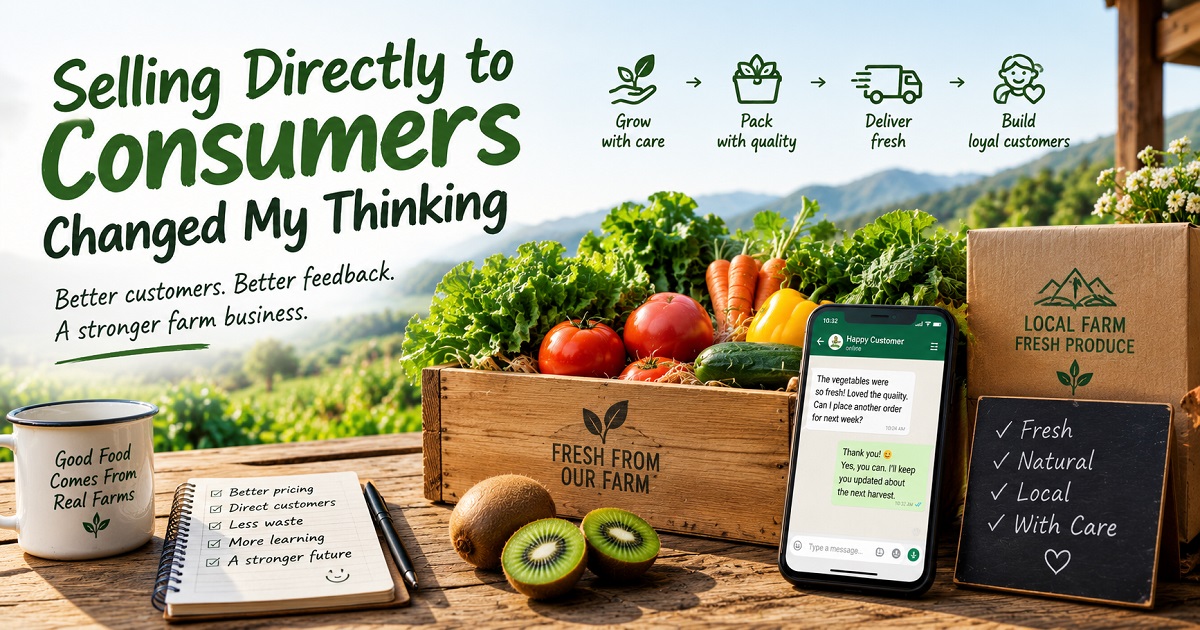
As A Farmer Selling Directly to Consumers Changed My Thinking
For a long time, I thought the most important part of farming was growing a good crop.
If the plants were healthy, the harvest was good and the quality was right, I assumed the rest would somehow work itself out.
It doesn’t.
One of the biggest changes in the way I think about farming came from looking beyond production and thinking seriously about who actually buys what I grow.
Selling directly to consumers changes that perspective completely.
When you sell through a traditional market channel, the farmer is often focused mainly on production. Grow the crop, harvest it, take it to the market and try to get the best possible price.
When you sell directly to a customer, suddenly the crop is no longer just a commodity.
There is a person on the other side.
That person wants to know where the food came from.
They care about freshness.
They may ask how it was grown.
They want the right quantity.
They may want it delivered on a particular day.
They may complain if something arrives damaged.
They may come back if they are happy.
And they may never order again if they aren’t.
That changes the way you look at the entire business.
For me, direct selling has made one thing particularly clear:
Farming doesn’t end when you harvest the crop. That’s where the selling part of the business begins.
And once you understand that, many things about farming start to look different.
The Farmer Usually Thinks About Production First
This is understandable.
There is so much to worry about on a farm.
Preparing the land.
Planting.
Irrigation.
Weeding.
Pest management.
Weather.
Fertilisation.
Pruning.
Harvesting.
Labour.
Machinery.
The list never ends.
So naturally, farmers tend to measure success through production.
How many kilograms did we produce?
How many crates did we harvest?
How many trees are productive?
How much yield did we get per acre?
These are important numbers.
But they don’t tell us whether the farm actually made a good business.
A farmer can produce a large quantity and still struggle financially.
And another farmer can produce a smaller quantity but earn more because he has a better market, stronger relationships with buyers, better branding or less wastage.
That difference became much more obvious to me when I started thinking about direct-to-consumer selling.
A Good Crop Doesn’t Automatically Mean a Good Business
This is probably one of the hardest lessons in agriculture.
We often hear:
“If you grow good-quality produce, buyers will come.”
I don’t think it is that simple.
Quality is necessary.
But quality alone doesn’t create a market.
A customer has to find you, trust you, understand your product, be willing to pay for it and have a convenient way to buy it.
That’s a completely different set of problems.
Imagine two farmers producing equally good tomatoes.
One takes everything to the wholesale market.
The other has 100 regular customers who know the farm, trust the farmer and buy every week.
Their farming may be almost identical.
Their businesses can be completely different.
This is why I’ve started looking at farming as a combination of several things:
Production + Marketing + Distribution + Customer Relationships.
The crop is only one part of the equation.
Direct Selling Makes You Think About the Customer
This is perhaps the biggest mental shift.
When your only customer is effectively the market, you don’t always get to know the person who eventually eats your produce.
Direct selling removes that distance.
You start receiving questions.
“Is this naturally grown?”
“When was it harvested?”
“How long will it stay fresh?”
“Can I get a smaller quantity?”
“Can you deliver on Saturday?”
“Do you have anything else?”
“Can I order again next week?”
Those questions are valuable.
They tell you what consumers actually care about.
And sometimes what customers care about is completely different from what farmers assume they care about.
A farmer may think:
“My product is good because it is large.”
The customer might care more about:
“Is it fresh?”
A farmer might focus on appearance.
The customer might care about taste.
A farmer might focus on producing more.
The customer might prefer a smaller quantity delivered fresh.
This feedback loop is extremely useful.
You Start Seeing Produce as a Product
This sounds like a small difference, but it isn’t.
Farmers often think in terms of crops.
Tomatoes.
Kiwi.
Beans.
Capsicum.
Apricots.
Consumers think in terms of products.
Fresh tomatoes for the week.
Premium kiwi.
A box of mixed vegetables.
Naturally grown produce.
Dried apricots.
A convenient farm box.
The difference is important because a crop is something you produce, while a product is something you sell.
Once you start thinking this way, you begin asking different questions.
How should it be presented?
What quantity makes sense?
What packaging should be used?
What should the customer know about it?
What makes it different?
How should it be priced?
How should it be delivered?
What happens if the customer isn’t satisfied?
Those are business questions.
And farmers need to become comfortable asking them.
The Mandi Is Not the Only Market
I’m not against traditional agricultural markets.
They are extremely important.
For many farmers, they provide scale, established buyers and a practical way to move large quantities.
But I don’t think farmers should automatically assume that the mandi or local trader has to be the only route to market.
There are many possible channels now.
A farmer can sell to:
- Local consumers
- Retail customers
- Restaurants
- Hotels
- Retail stores
- Institutional buyers
- Wholesalers
- Processors
- Online customers
- Subscription customers
- Farmer groups
- Direct farm-to-consumer platforms
The right channel depends on the crop, quantity, location, shelf life and economics.
Direct selling isn’t automatically better.
That’s important.
If I have several tonnes of a highly perishable crop and only a small number of customers, direct selling may create a logistical nightmare.
But for differentiated, premium or smaller-volume produce, direct sales can create opportunities that traditional commodity markets may not provide.
The question shouldn’t be:
“Should farmers stop using mandis?”
It should be:
“Can farmers create more than one route to market?”
I think diversification of markets can be just as important as diversification of crops.
Direct-to-Consumer Doesn’t Mean Selling One Tomato at a Time
There is another misconception about direct selling.
People sometimes imagine a farmer standing in a shop and selling individual vegetables directly to people.
That’s one model.
But direct-to-consumer agriculture can take many forms.
For example:
Weekly farm boxes
A customer subscribes to receive fresh produce every week.
Pre-orders
The farmer collects orders before harvesting.
Seasonal sales
Customers order a particular crop when it is in season.
Community buying
A group of customers collectively purchases from a farmer.
Online ordering
Customers order through a website, WhatsApp or another digital platform.
Local delivery
The farmer delivers within a defined geographic area.
Pickup points
Customers collect their orders from a convenient location.
The important thing is to design the model around the economics of the farm.
Not around what sounds fashionable.
Pre-Orders Can Change the Economics
One idea I find particularly interesting is selling before harvesting.
Traditional farming often works like this:
Grow → Harvest → Search for buyer → Sell.
Direct selling can potentially reverse the process:
Find demand → Take orders → Plan harvest → Harvest → Deliver.
That doesn’t mean everything should be pre-sold.
But even partial demand visibility can be valuable.
Suppose I know that customers want 50 kg of a particular vegetable this weekend.
That information can influence harvesting and packing.
It can reduce unnecessary harvesting.
It can reduce wastage.
It can make logistics easier.
And most importantly, it gives the farmer some understanding of demand before the produce leaves the farm.
That is powerful information.
But Direct Selling Is Not Easy
This is where I think many discussions about “farm to consumer” become unrealistic.
Direct selling sounds attractive.
Higher price.
Closer relationship.
Better margins.
No middleman.
But there is a lot more work involved.
Someone has to:
- Find customers
- Answer messages
- Take orders
- Confirm quantities
- Collect payments
- Harvest
- Sort
- Pack
- Label
- Store
- Transport
- Deliver
- Handle complaints
- Manage replacements
- Track repeat customers
And all of this happens while you still have to run the farm.
That’s why I don’t think direct selling should be presented as a simple way to “eliminate the middleman.”
The middleman often performs real functions.
The better question is:
Which functions can the farmer perform profitably, and which are better handled by someone else?
That is a much more practical way of looking at it.
The Middleman Isn’t Always the Problem
This is an important lesson.
It is easy to say:
“Farmers earn less because middlemen take the margin.”
Sometimes there are inefficiencies in the chain.
But a trader or distributor may also be providing:
- Transportation
- Aggregation
- Sorting
- Storage
- Credit
- Market access
- Risk absorption
- Buyer relationships
If a farmer removes that person from the chain, the farmer may also inherit those responsibilities.
So I don’t think the goal should always be removing intermediaries.
The goal should be creating more value for the farmer while keeping the overall system efficient.
Sometimes direct selling does that.
Sometimes a good trader does.
Sometimes a farmer producer organisation does.
Sometimes a combination works best.
Price Is Not the Same as Profit
This is another lesson that direct selling makes very obvious.
Suppose a farmer normally gets ₹40 per kilogram through a traditional channel.
A direct customer is willing to pay ₹70.
It looks like an obvious win.
But now calculate everything.
Packaging.
Labour.
Sorting.
Transportation.
Delivery.
Payment processing.
Customer acquisition.
Spoilage.
Time spent communicating.
Returns or replacements.
Suddenly that ₹70 may not be as attractive as it first appeared.
This is why farmers need to calculate net margin, not just selling price.
A simple calculation can be:
Selling Price – Production Cost – Packaging – Transportation – Selling Cost – Wastage = Actual Margin
The numbers will vary from farm to farm.
But the principle is universal.
A higher selling price doesn’t automatically mean higher profit.
Customer Acquisition Is a Real Cost
This is something farmers entering direct selling sometimes overlook.
Getting the first customer can be difficult.
You may have excellent produce, but nobody knows you exist.
You might need:
- Social media
- A website
- Local advertising
- WhatsApp groups
- Referrals
- Events
- Partnerships
- Content
- Sampling
All of that takes time or money.
But once you acquire a customer, something interesting can happen.
If the customer likes the product and trusts you, they may buy again.
And again.
And again.
That is where the economics can improve.
A farmer shouldn’t think only about:
“How much did I make from this order?”
The better question may be:
“Can this customer become a customer for the next three years?”
That changes the entire calculation.
Repeat Customers Are More Valuable Than One-Time Buyers
Imagine selling ₹1,000 worth of produce to ten different people once.
That’s ₹10,000 in sales.
Now imagine having ten customers who each spend ₹1,000 every month for twelve months.
That’s ₹1,20,000 in annual sales from the same ten relationships.
Obviously, real life is not that predictable.
Customers leave.
Orders fluctuate.
Production changes.
But the principle is important.
Customer retention can be more valuable than constantly searching for new customers.
This is why consistency matters.
If you promise fresh produce every Saturday, try to make Saturday reliable.
If you say a product was harvested recently, be honest.
If something is unavailable, communicate early.
Trust is built through small interactions.
Trust Is More Important When You Sell Food
A customer isn’t buying a phone charger.
They’re buying something they are going to eat.
That makes trust particularly important.
People want to know:
Where did this come from?
Who grew it?
How was it grown?
When was it harvested?
How was it handled?
Can I trust the claims being made?
This is why I believe transparency will become increasingly important in direct agricultural businesses.
Don’t make exaggerated claims.
Don’t call everything “organic” just because it sounds better.
Don’t make health promises that you cannot support.
Instead, explain honestly what you do.
Tell the story of the farm.
Show the actual process.
Let customers understand what they are buying.
Trust is a business asset.
Your Farm Story Becomes Part of the Product
This is another thing that changed my thinking.
When you sell through a commodity channel, the identity of the farmer can disappear.
The produce becomes a quantity.
A grade.
A price.
A crate.
Direct selling gives you the opportunity to put the farmer back into the story.
Where is the farm?
What does the farm look like?
Why did you choose this way of farming?
What challenges do you face?
When is the crop harvested?
Why is your produce different?
These aren’t just marketing questions.
They help customers understand the value behind the product.
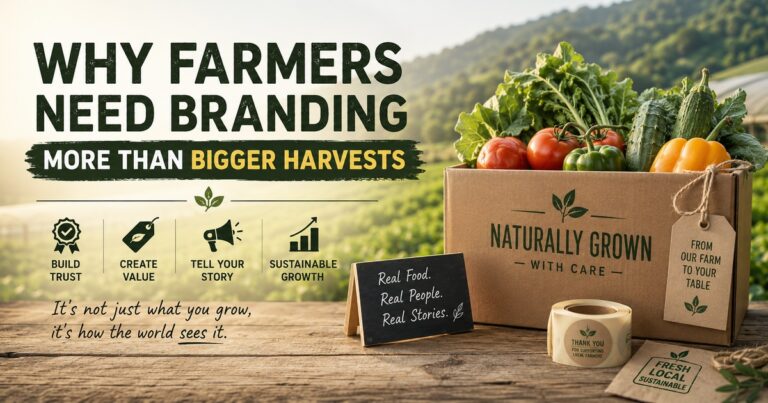
And this connects strongly with branding.
A farmer doesn’t necessarily need an expensive logo or fancy packaging to build a brand.
A brand starts with a consistent promise that customers believe.
Packaging Suddenly Matters
When selling to a wholesale buyer, packaging may have one primary purpose: moving the produce efficiently.
When selling directly, packaging becomes part of the customer experience.
Think about receiving two boxes.
One arrives damaged, dirty and poorly organised.
The other is clean, properly packed and clearly labelled.
The produce inside may be almost identical.
But the customer’s perception won’t be.
Good packaging doesn’t mean expensive packaging.
It means appropriate packaging.
For fresh produce, that might mean:
- Correct ventilation
- Protection from damage
- Suitable box size
- Clean presentation
- Clear labelling
- Harvest or packing information where appropriate
The goal isn’t to make the package look luxurious.
The goal is to protect the product and communicate care.
Freshness Can Become Your Competitive Advantage
One of the biggest advantages of direct selling is potentially shortening the distance between harvest and consumption.
A farmer can potentially harvest closer to the time of delivery rather than harvesting based entirely on wholesale market schedules.
For highly perishable produce, that can matter enormously.
And freshness is something customers understand immediately.
You don’t have to explain it with complicated marketing.
They taste it.
They see it.
They experience it.
This is why direct selling works particularly well for some categories of agricultural products.
But again, it depends on logistics.
Freshness only becomes an advantage if you can consistently deliver it.
You Start Understanding What Customers Actually Want
Farmers sometimes make assumptions about demand.
We think:
“Everyone wants the biggest fruit.”
Maybe they don’t.
We think:
“Customers will pay more because it is naturally grown.”
Maybe they will, but only if they trust the claim and see the difference.
We think:
“People want large quantities.”
Some do.
Others may prefer smaller quantities because they don’t want food to spoil.
Direct selling gives you actual feedback.
And that feedback can influence production.
That may be one of its greatest benefits.
Instead of producing first and asking questions later, farmers can gradually learn what their customers value.
Direct Selling Can Influence What You Grow
This is where marketing and farming start becoming connected.
Suppose customers consistently ask for a particular vegetable.
Or they want smaller packs.
Or they prefer mixed produce boxes.
Or they are willing to pay a premium for a particular variety.
That information can influence next season’s decisions.
Suddenly, customers are indirectly helping shape your production plan.
This is very different from simply planting because:
“We always grow this.”
Agriculture becomes more market-oriented.
Not market-controlled.
There is an important difference.
Farmers should not chase every trend.
But understanding demand can help them make better decisions.
Technology Makes This Easier
This is where my interest in technology naturally connects with farming.
Direct selling used to require a physical shop, phone calls and a lot of manual coordination.
Today, even a small farm can use digital tools.
A simple system could include:
Website → Product catalogue → Order form → Payment → Order confirmation → Harvest → Packing → Delivery → Customer feedback
You don’t necessarily need complicated software.
Even a simple combination of a website, spreadsheet, messaging application and digital payment system can help a small operation become more organised.
As the business grows, technology can handle more.
Customer records.
Inventory.
Orders.
Invoices.
Delivery routes.
Repeat orders.
Marketing.
Analytics.
And eventually, AI could help with some of these activities as well.
But technology should solve a problem.
It shouldn’t be added simply because it sounds modern.
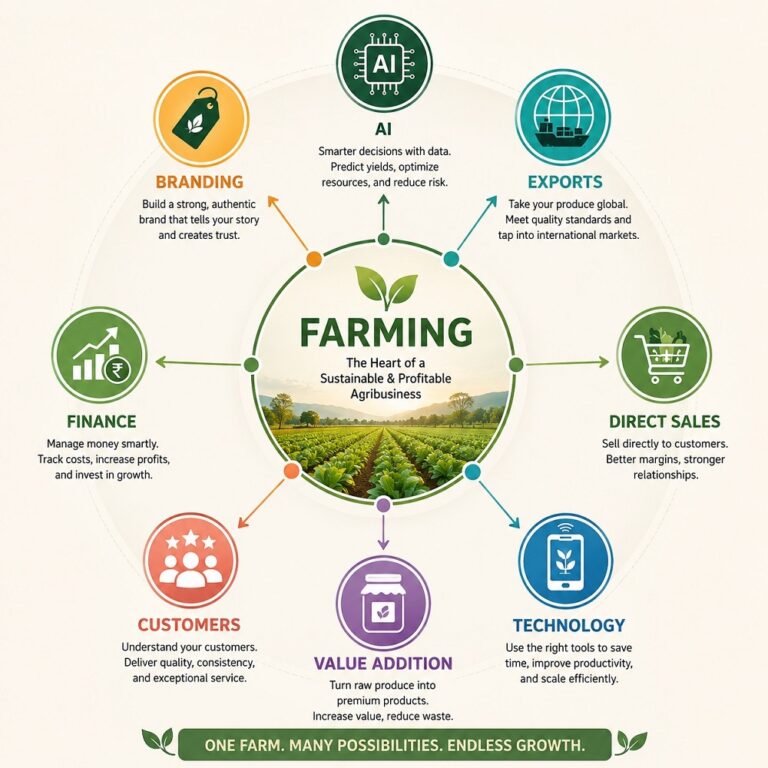
I Now Think About the Farm as a Complete System
This is probably the biggest change in my thinking.
Earlier, it was easy to think:
Farm → Crop → Harvest → Sale
Now I see something more like:
Land → Production → Quality → Harvest → Sorting → Packaging → Brand → Customer → Delivery → Feedback → Repeat Purchase
Every stage affects the final business.
A beautiful crop can lose value because of poor handling.
A good product can remain unsold because nobody knows about it.
A strong brand can lose trust because delivery is unreliable.
A good customer relationship can be destroyed by poor communication.
This is why farming is much more than production.
It is a system.
Direct Selling Also Forces You to Understand Your Numbers
If you’re selling through a conventional channel, you may mostly track production and the final sale.
Direct selling forces you to track much more.
For example:
How much did I produce?
How much did I sell?
How much was wasted?
What was the average order value?
How much did delivery cost per order?
How many customers ordered again?
Which products sell most frequently?
Which customers buy the most?
Which delivery areas are profitable?
These numbers can reveal things that intuition misses.
Maybe one product has a high selling price but poor margins.
Maybe another product sells at a lower price but gets repeat orders.
Maybe a particular delivery area costs too much to serve.
Maybe customers in one area prefer premium packaging.
This is where agriculture starts looking much more like any other business.
Not Every Farmer Needs to Sell Directly
I want to make this clear.
I don’t think every farmer should suddenly start selling directly to consumers.
It isn’t practical for everyone.
A farmer producing large volumes of wheat, rice or another commodity may have completely different economics.
A farmer far away from large consumer markets may find delivery too expensive.
A farmer without the time or interest to manage customers may prefer a reliable buyer.
That’s perfectly fine.
Direct selling is a business model, not a rule.
The important thing is to understand the alternatives.
If direct selling works, use it.
If wholesale works better, use it.
If institutional buyers work better, explore them.
If processing creates better margins, consider value addition.
If several farmers can work together, aggregation may make sense.
The goal is not to follow a trend.
The goal is to build a sustainable agricultural business.
The Biggest Lesson: Don’t Be Afraid of the Market
Farmers often say:
“I just want to grow. Someone else should handle the selling.”
I understand that.
Selling can be uncomfortable.
You have to talk to customers.
You have to negotiate.
You have to hear complaints.
You have to explain your prices.
You have to deal with people who compare your product with something cheaper.
But avoiding the market also means giving up valuable information.
When you speak to customers, you learn.
You learn what they value.
You learn what they don’t care about.
You learn what they’re willing to pay for.
You learn what frustrates them.
You learn what makes them come back.
That knowledge can eventually make you a better farmer and a better businessperson.
What I Would Do Differently If I Were Building a Farm Business From Scratch
I wouldn’t start with:
“What can I grow?”
I’d start with:
“Who do I want to sell to?”
Then I’d ask:
What does that customer want?
Where are those customers?
How often do they buy?
What quantity do they need?
What are they willing to pay?
What makes them trust a farmer?
How much will delivery cost?
What happens if I can’t supply them?
Then I’d work backwards into production.
Of course, farming doesn’t always allow such perfect planning.
Weather doesn’t care about your business plan.
Crops fail.
Demand changes.
Markets fluctuate.
But starting with the customer can prevent one common mistake:
producing something first and searching for a buyer later.
Start Small
If a farmer wants to experiment with direct selling, I don’t think the answer is to immediately build a large online store.
Start with a small group.
Maybe 10 customers.
Then 20.
Learn what happens.
Take feedback.
Track your costs.
Understand delivery.
See what gets reordered.
Fix problems.
Then grow.
This is much safer than investing heavily before understanding whether the model actually works.
The first goal isn’t maximum sales.
The first goal is learning the system.
Build a Customer List, Not Just Social Media Followers
This is another practical point.
A farmer may have thousands of followers on social media but very few paying customers.
Followers are useful.
But customers are the business.
A customer list with permission to communicate can be much more valuable.
Keep basic information:
- Name
- Location
- Products purchased
- Purchase frequency
- Preferred delivery day
- Feedback
You don’t need to make it complicated.
The objective is to understand your customers and serve them better.
Don’t Promise What You Cannot Deliver
This sounds obvious, but it becomes extremely important in direct selling.
If you have limited production, don’t accept unlimited orders.
If weather affects availability, tell customers.
If delivery is only possible on certain days, communicate that clearly.
If a product isn’t available, don’t pretend it is.
One of the biggest advantages a small farmer can have is honesty.
Large businesses spend enormous amounts of money trying to build consumer trust.
A small farmer can sometimes build it through simple transparency.
The Farmer’s Role Is Changing
I think the future farmer will have to wear more than one hat.
Farmer.
Businessperson.
Marketer.
Negotiator.
Data collector.
Customer-service representative.
Maybe even content creator.
Technology will help with some of these responsibilities.
But the mindset needs to change first.
We need to stop thinking of the farmer as someone whose job ends at the farm gate.
The farmer can increasingly become part of the entire value chain.
Not necessarily all of it.
But more of it.
Direct Selling Changed the Way I Define “Good Farming”
Today, I wouldn’t define good farming only by yield.
I’d look at several things.
Did I produce good-quality food?
Did I manage the land responsibly?
Did I control my costs?
Did I reduce unnecessary waste?
Did I find a suitable market?
Did customers trust the product?
Did they come back?
Did the business make a reasonable margin?
Did the model work without exhausting the farmer?
That last question matters.
A business that makes money but requires unsustainable effort isn’t necessarily a good business.
The model has to work for the farmer too.
The Future May Not Be Farm-to-Consumer. It May Be Farmer-to-Relationship.
The phrase “farm-to-consumer” sounds like it is mainly about removing distance.
But I think the deeper opportunity is about removing information gaps.
The customer can know more about the farm.
The farmer can know more about the customer.
The customer can communicate what they want.
The farmer can respond.
That creates a relationship.
And relationships are difficult for commodity markets to create.
A kilogram of tomatoes has a market price.
But a customer who says:
“I always buy my vegetables from your farm because I trust you.”
has something different.
That is a brand.
That is loyalty.
And that is much harder for a competitor to copy.
My Biggest Takeaway
Selling directly to consumers didn’t make me think that farmers should abandon traditional markets.
It made me realise that farmers should understand their market better.
It made me look beyond yield.
Beyond the farm gate.
Beyond the mandi price.
Beyond the simple question:
“How much did I get for my crop?”
Now I think about a different set of questions.
Who bought it?
Why did they buy it?
Would they buy it again?
What did they like?
What didn’t they like?
What did it cost me to serve them?
Can I improve the experience?
Can I build trust?
Can I create a product instead of simply selling a commodity?
Those questions have changed how I look at farming.
And perhaps the most important lesson is this:
The farmer who understands the customer has a much better chance of understanding the business.
I still care deeply about growing good crops.
That’s where everything begins.
But I no longer think that’s where the job ends.
The future I see for small farmers isn’t necessarily about becoming huge.
It is about becoming smarter, more connected and more valuable.
Grow something good.
Know who wants it.
Tell them why it matters.
Deliver it properly.
Listen to them.
Improve.
And build the relationship again next season.
That’s a very different way of looking at farming.
And for me, that’s what selling directly to consumers has changed.
It has made me realise that the farm is not just where the product begins. It is where the relationship begins.