Why I Chose Natural Farming: What the Soil, the Farm and the Market Taught Me
There was a time when I thought about farming mainly in terms of production.
How much can I grow?
How can I increase yield?
Which input should I use?
How can I protect the crop?
These are natural questions for any farmer. At the end of the season, the numbers matter. A farm has to produce enough income to support the family and justify the effort, investment and risk involved.
But over time, I started asking a different question:
What kind of farm do I want to leave behind?
That question changed the way I look at agriculture.
For me, choosing natural farming was not about suddenly deciding that everything done in conventional agriculture was wrong. It was not about following a trend, using a particular recipe, or believing that one farming method can solve every agricultural problem.
It was a gradual shift in thinking.
I started looking at the farm as a living system rather than simply a place where crops are produced.
The soil is alive.
The roots are interacting with microorganisms.
Crop residues have value.
Water has value.
Biodiversity has value.
And every decision I make today can affect what the farm will be capable of producing years from now.
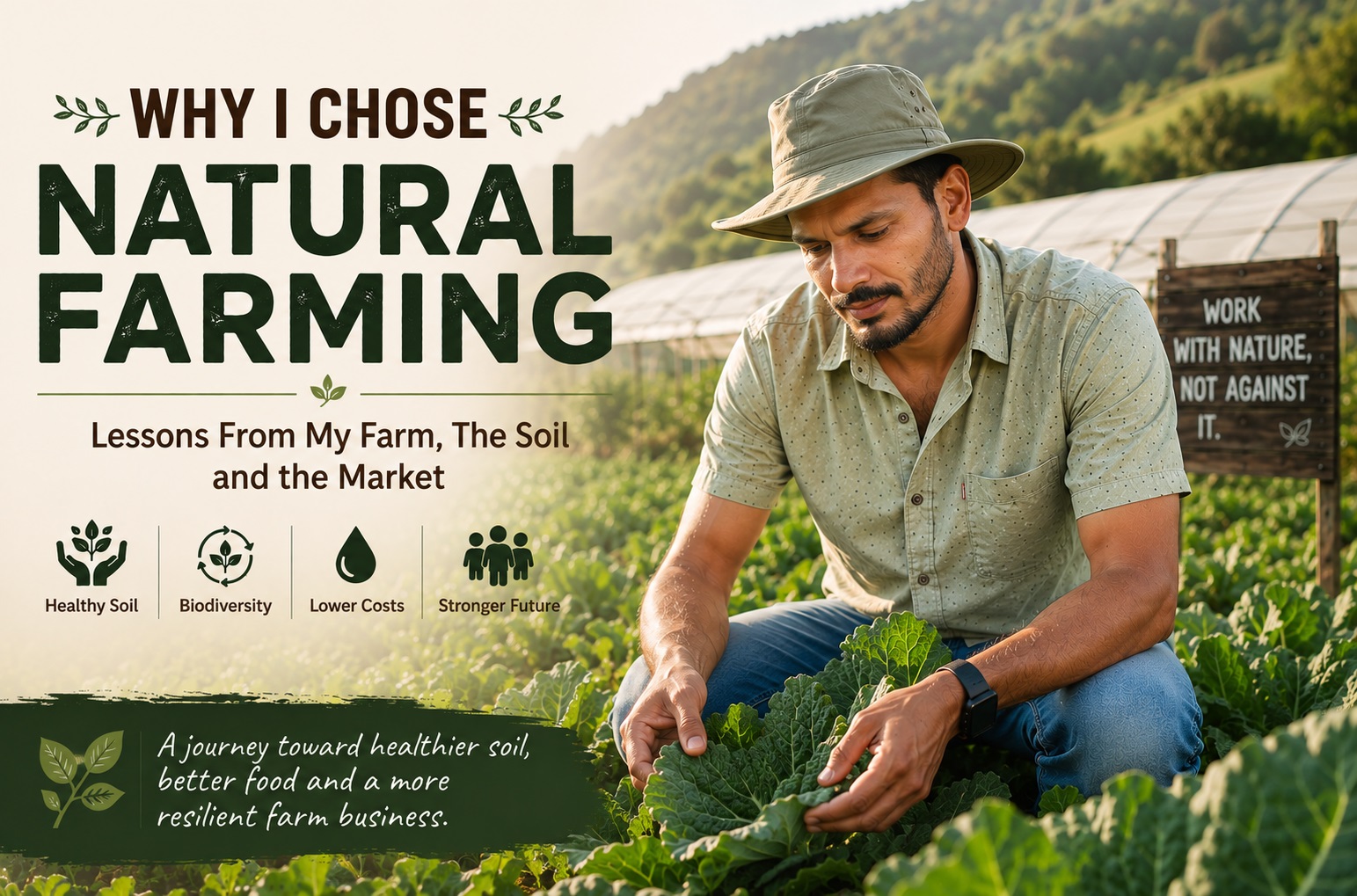
That is the reason I chose natural farming.
I want to grow food, but I also want to build a farm that remains productive, resilient and economically viable for the long term.
Farming Is Not Just About Growing More
One of the biggest lessons farming has taught me is that more production does not automatically mean more profit.
A farmer can produce more and still earn less.
Why?
Because farming has two sides.
There is the production side:
- Seeds
- Soil
- Water
- Nutrition
- Pest management
- Labour
- Weather
And then there is the business side:
- Input costs
- Market prices
- Transportation
- Storage
- Packaging
- Marketing
- Customer relationships
- Post-harvest losses
A farmer who focuses only on increasing production can easily miss half of the business.
This is where natural farming became interesting to me.
Rather than asking only, “How can I give the crop more inputs?”, I began thinking:
Can I make the farm itself more productive as an ecosystem?
Can I improve the soil?
Can I recycle more biomass?
Can I keep the soil covered?
Can I diversify crops?
Can I reduce unnecessary dependence on purchased inputs?
Can I make better use of resources already available around the farm?
These questions are at the heart of natural farming.
NITI Aayog describes natural farming as a diversified, agro-ecological system that integrates crops, trees and livestock and emphasizes natural processes, biodiversity and on-farm resources. Its principles include maintaining soil cover, minimizing soil disturbance, increasing crop diversity, returning organic residues to the soil and using ecological approaches to pest management.
That way of thinking made sense to me.
My Decision Was Not About “Chemical vs Natural”
There is an important distinction I want to make.
I don’t think agriculture should be reduced to a simple argument of:
Chemical farming is bad. Natural farming is good.
Real farming is more complicated.
Farmers operate under different climates, soils, crops, market conditions and financial constraints.
A practice that works beautifully in one location may require modification somewhere else.
A farmer growing vegetables on a small diversified farm has different challenges from a farmer managing hundreds of acres of a single crop.
An orchard has different requirements from an annual vegetable crop.
Rainfed agriculture is different from irrigated agriculture.
So I don’t see natural farming as a rigid checklist.
I see it as a way of thinking about the farm.
The central idea that appealed to me was simple:
Work with natural processes instead of constantly trying to overcome them.
That doesn’t mean doing nothing.
In fact, natural farming requires observation.
You have to watch the soil.
You have to understand moisture.
You have to observe pests before they become a serious problem.
You have to understand crop combinations.
You have to manage biomass.
You have to pay attention to timing.
In many ways, it makes the farmer more involved-not less.
The Soil Became More Important to Me
Earlier, it was easy to think of soil simply as the medium in which a crop grows.
Now I think about it differently.
Soil is not dead material.
It is an ecosystem.
It contains microorganisms, organic matter, roots, insects and countless interactions that influence how plants grow.
NITI Aayog’s natural-farming framework places a healthy soil microbiome at the centre of soil and plant health and emphasizes soil cover, crop diversity, minimal disturbance and returning organic matter to the soil.
This changed the way I look at things like crop residues.
A leftover plant is not necessarily waste.
It can become part of the next cycle.
Leaves can return to the soil.
Organic matter can become a resource.
Mulching can help protect the soil surface.
Different crops can occupy different ecological niches.
Instead of thinking:
“How do I keep the field clean?”
I increasingly think:
“How do I keep the soil healthy?”
That is a very different mindset.
A perfectly clean field may look good to the human eye, but nature doesn’t necessarily work that way.
In a forest, nobody removes every fallen leaf.
Nobody sprays the forest every time an insect appears.
Nobody tills the soil before every new plant emerges.
The ecosystem is constantly recycling.
Of course, a farm is not a forest. We are deliberately growing crops for food and income, so farmers have to intervene.
But there is something valuable in understanding how natural systems maintain themselves.
Natural Farming Made Me Think About Inputs Differently
Another reason I became interested in natural farming was the economics of farming inputs.
A farm that depends heavily on purchased inputs can become increasingly exposed to price changes.
If fertilizer prices rise, the farmer pays more.
If pesticide prices rise, the farmer pays more.
If fuel becomes expensive, transportation and field operations become more expensive.
At the same time, the farmer often has little control over the selling price of the crop.
That creates a difficult equation:
Input costs are often under the farmer’s control only to a limited extent, while output prices are frequently determined by the market.
Reducing unnecessary external dependence therefore becomes a business question, not just an environmental question.
Research compiled by NITI Aayog has found evidence from natural-farming studies that lower cultivation costs can contribute to improved farm economics, even where yields are not necessarily higher. One ICAR-NAARM study summarized by NITI Aayog concluded that natural farming may not always increase yield but can improve farmer income through lower cultivation costs and, in some cases, better prices for chemical-free produce.
That distinction is extremely important.
The goal isn’t always maximum yield.
The goal should be a healthy relationship between:
Revenue − Cost = Profit
Sometimes reducing cost can be just as important as increasing production.
For a farmer, that can make a huge difference.
But I Don’t Believe Natural Farming Means “Zero Cost”
This is another misconception I want to avoid.
Natural farming is sometimes described as if it means farming without spending money.
That isn’t realistic.
A farm still requires labour.
It needs irrigation infrastructure.
It may require fencing.
It needs tools.
It needs transportation.
It needs packaging.
It needs harvesting.
It needs marketing.
It may need livestock or access to farm-based biological resources.
And perhaps most importantly, it requires knowledge and time.
Preparing inputs, managing biomass, observing crops and maintaining diversity all require effort.
So I prefer to think about natural farming as reducing unnecessary external input dependence, not as magically eliminating every farming cost.
That distinction matters if we want agriculture to be treated as a serious business.
Why This Approach Makes Sense in the Hills
Farming in the hills brings its own set of challenges.
Terrain is different.
Land can be fragmented.
Transportation is more difficult.
Weather can change quickly.
Water management matters enormously.
Labour availability can be a challenge.
And moving heavy external inputs to farms is not always simple.
In Himachal Pradesh, natural farming has already received significant policy attention through the state’s Prakritik Kheti Khushhal Kisan programme, which was designed around reducing cultivation costs and improving farmer incomes. NITI Aayog reports that the programme promoted production of food grains, vegetables and fruits without synthetic pesticides and fertilizers.
For me, the idea of making better use of what is available locally therefore has particular relevance.
A farming system that encourages recycling biomass, maintaining soil cover, diversifying crops and reducing unnecessary external dependence can potentially fit well with a hill farming environment.
But again, the farm has to decide what actually works.
Natural farming should not become a religion.
It should remain a practical agricultural system.
My Farm Is More Than One Crop
Another reason I was attracted to natural farming is diversification.
A farm doesn’t have to be only one crop.
In my own farming journey, kiwi has become an important part of what I grow, but I also grow vegetables and other produce.
That diversity changes the way I think about farming.
Different crops have different seasons.
Different crops have different market opportunities.
Some provide relatively quick returns.
Others are longer-term investments.
Some can be consumed fresh.
Others can potentially be processed.
This creates something very important:
risk diversification.
If one crop has a bad season, another crop may perform better.
If the price of one commodity falls, another product may have stronger demand.
If a particular pest becomes a problem, a diversified farm may be less vulnerable than a highly simplified system.
NITI Aayog’s natural-farming principles explicitly emphasize crop diversity, with diversified systems intended to support ecological functions and resilience.
This is one of the things I find most interesting about natural farming.
Biodiversity isn’t just an environmental concept.
It can also be a business strategy.
Natural Farming Changed How I Think About Pests
When you see an insect on a crop, the immediate reaction can be:
“How do I kill it?”
But that isn’t always the right first question.
The better questions may be:
- What insect is it?
- Is it actually damaging the crop?
- How severe is the problem?
- What stage is the crop in?
- Are there beneficial insects present?
- Can cultural or mechanical practices reduce the problem?
- Is intervention actually necessary?
Natural farming encourages a more ecological approach to pest management, including better agronomic practices and botanical approaches where necessary.
That mindset has value even beyond natural farming.
It teaches the farmer to observe before acting.
And observation is one of the most underrated skills in agriculture.
I Also Started Thinking Differently About Water
Water is one of the most important resources on any farm.
The question isn’t simply:
“How much water does my crop need?”
It is also:
“How efficiently can my farm retain and use the water it receives?”
Keeping soil covered, increasing organic matter and maintaining healthy soil structure can support better water management.
NITI Aayog highlights soil cover, diversified cropping and other natural-farming practices as ways to reduce unnecessary water loss and improve water-use efficiency.
For a farmer, this isn’t an abstract environmental benefit.
Water costs money.
Pumping costs money.
Infrastructure costs money.
And in many parts of India, water availability itself is becoming an increasingly important constraint.
So protecting the soil’s ability to hold and use water is both an ecological and economic decision.
Natural Farming Does Not Mean Going Backwards
This is perhaps one of the biggest misconceptions.
Some people hear “natural farming” and imagine that farmers should reject modern technology.
I don’t agree.
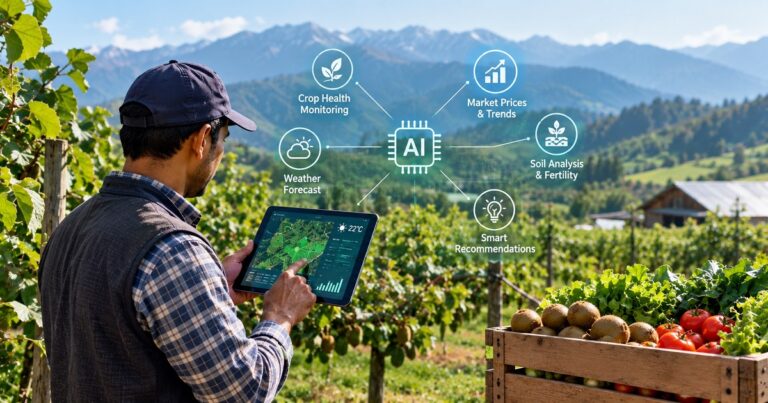
I work with technology, and I see enormous potential for technology in agriculture.
A natural farmer can still use:
- Weather forecasting
- Soil testing
- Digital farm records
- Drip irrigation
- Sensors
- Mobile applications
- Satellite imagery
- Artificial intelligence
- Digital marketplaces
- Modern packaging
- Online marketing
There is no contradiction.
Natural farming and technology can work together.
In fact, I believe technology may make natural farming more measurable and commercially viable.
Imagine keeping digital records of:
- Crop inputs
- Labour
- Irrigation
- Weather
- Pest observations
- Harvest quantity
- Selling price
- Customer feedback
Once you have that information, you can start asking better questions.
Which crop is actually profitable?
Which practice reduced costs?
Which field performed better?
Which customer segment pays more?
Which product has the lowest wastage?
Which month gives the best price?
This is where my interest in technology and agriculture naturally comes together.
The Farmer of the Future Needs to Understand Data
Agriculture has traditionally depended heavily on experience.
That experience remains incredibly valuable.
But I believe the next generation of farmers will combine experience with data.
For example, imagine a farmer maintaining records for five years.
They might discover:
- One field consistently retains moisture better.
- One crop combination performs better.
- One pest appears during a predictable weather pattern.
- One variety produces better market returns.
- One customer segment is willing to pay a premium.
- One cultivation practice reduces costs significantly.
Without records, these things may remain observations.
With records, they become information.
With enough information, they can become decisions.
And eventually, technology can help turn those decisions into systems.
That is one of the reasons I don’t see natural farming as anti-technology.
I see it as an opportunity to use technology more intelligently.
Natural Farming Also Made Me Think About Food Differently
There is another side of the story that is often ignored.
Farmers grow food for other people.
When I grow vegetables or fruit, I am not just producing a commodity.
Someone eventually eats it.
That changes the question from:
“How much can I produce?”
to:
“What kind of food am I comfortable putting in front of another family?”
That doesn’t mean making exaggerated claims about health or saying that every naturally grown product is automatically superior.
It means taking responsibility for how food is produced.
Consumers increasingly want to know more about their food.
They want freshness.
They want transparency.
They want to know who grew it.
They want confidence in the production process.
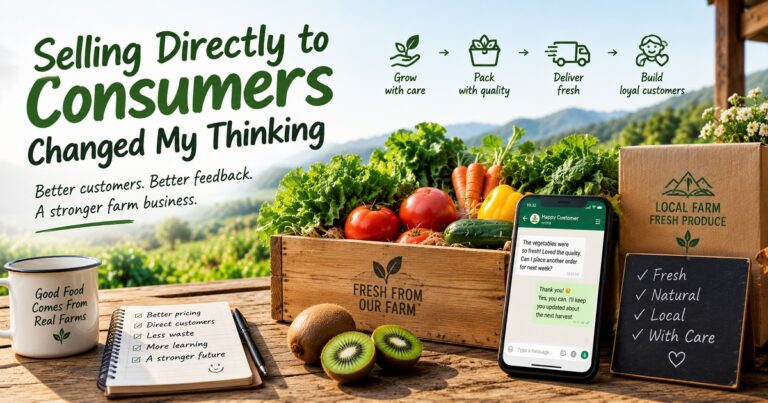
That creates an opportunity for farmers to build relationships directly with consumers.
And that brings me to another important lesson.
Natural farming alone does not create a successful business.
The farmer still needs a market.
Growing Naturally Is Only Half the Story
Suppose I grow excellent vegetables.
What happens next?
If I don’t know where to sell them, the quality doesn’t automatically create profit.
If the produce is damaged during transportation, quality is lost.
If packaging is poor, customers may not trust the product.
If I cannot communicate how the food was grown, the customer may see it as just another vegetable.
This is why I increasingly see farming as a complete business system.
Production → Harvest → Grading → Packaging → Marketing → Distribution → Customer → Feedback
Natural farming influences the production side.
But the farmer still has to build the rest of the chain.
That is why I am interested in direct-to-consumer models, branding and technology alongside farming.
The future farmer may need to be part farmer, part entrepreneur, part marketer and part technologist.
The Market Has to Reward Better Farming
There is also an uncomfortable question.
If natural farming requires more observation, knowledge and sometimes more labour, will the market reward it?
That is still a work in progress.
Farmers cannot survive on good intentions.
If consumers want naturally grown food, they need to be willing to recognize its value.
But farmers also need to earn that trust.
That means making credible claims.
Being transparent.
Maintaining consistency.
Avoiding exaggerated marketing.
And, where relevant, using appropriate certification or residue testing rather than simply putting the word “natural” on a label.
This is important because the future of natural farming depends not only on farmers but also on trust between farmers and consumers.
What Natural Farming Has Taught Me About Business
Interestingly, the lessons I have learned from natural farming go beyond agriculture.
The first is reduce unnecessary dependency.
In business, depending entirely on one customer is risky.
In farming, depending entirely on external inputs can also create vulnerability.
The second is diversification matters.
A diversified farm can spread risk across crops and markets.
A diversified business can spread risk across products and customers.
The third is build the foundation first.
Healthy soil takes time.
So does a strong brand.
So does customer trust.
So does a profitable agricultural business.
The fourth is observe before making decisions.
This applies equally to farming and technology.
Don’t blindly follow a trend.
Collect information.
Understand the situation.
Then act.
I Don’t Claim That Natural Farming Is Easy
If someone tells you that natural farming is effortless, I would be skeptical.
It isn’t.
Changing a farming system takes time.
There can be a learning curve.
Farmers need to understand their own soil, crops, climate and markets.
Results can vary.
And not every natural-farming practice will work equally well everywhere.
Even government-backed evidence is more nuanced than some social-media claims. For example, a NITI Aayog summary of a CSTEP comparison in Andhra Pradesh reported lower cultivation costs and resource use in the studied ZBNF systems, but also noted that yields were not uniformly higher across crops.
That is exactly why I think farmers should approach natural farming with curiosity rather than blind faith.
Try.
Observe.
Measure.
Learn.
Adapt.
And keep improving.
Natural Farming Is Also About Resilience
The older I get, the more I realize that a successful farm isn’t necessarily the farm that produces the highest output in a perfect year.
It may be the farm that survives difficult years.
Weather extremes.
Market crashes.
Input price increases.
Labour shortages.
Pest outbreaks.
Water problems.
A resilient farm has more tools available to respond.
Healthy soil.
Crop diversity.
Local resources.
Knowledge.
Good records.
Strong customer relationships.
Multiple income streams.
And the ability to adapt.
NITI Aayog identifies resilience, soil health, biodiversity and reduced dependence on external inputs among the broader objectives associated with natural farming.
That long-term perspective is one of the strongest reasons I continue to believe in this approach.
What I Am Still Learning
I don’t want this article to sound like I have figured everything out.
I haven’t.
Farming is too complex for that.
Every season teaches something new.
Sometimes a crop performs better than expected.
Sometimes it doesn’t.
Sometimes a farming decision looks good on paper but behaves differently in the field.
Sometimes the market teaches a lesson that the farm cannot.
And sometimes the simplest observation-something you notice while walking through the field-can be more valuable than a complicated theory.
That is what keeps farming interesting for me.
I am still learning how the soil responds.
Still learning how crops behave.
Still learning how consumers think.
Still learning how to market agricultural produce.
Still learning how technology can genuinely help farmers rather than simply adding another complicated tool.
And I think that willingness to keep learning is more important than pretending to know everything.
Why I Chose Natural Farming
So, why did I choose natural farming?
Not because I believe conventional farmers are doing everything wrong.
Not because natural farming is easy.
Not because I believe every natural input is automatically better.
And not because I expect one method to solve all of agriculture’s problems.
I chose it because I wanted to think differently about what a farm should be.
I wanted to place greater importance on soil.
I wanted to reduce unnecessary dependence on external inputs.
I wanted to encourage biodiversity and make better use of resources available around the farm.
I wanted to grow food in a way that I could feel comfortable standing behind.
And I wanted to build a farming business that could remain viable for the long term.
For me, natural farming is ultimately about working with the farm rather than constantly fighting against it.
It is about treating soil as an asset rather than an input.
It is about seeing crop residues as resources rather than waste.
It is about seeing biodiversity as part of the farming system rather than an inconvenience.
It is about looking at costs as carefully as yields.
And it is about understanding that farming doesn’t end when the crop leaves the field.
My View of the Future
I don’t think the future of Indian agriculture will be completely conventional.
I also don’t think it will be completely natural.
I believe the future will belong to farmers who are willing to learn, experiment and combine the best available knowledge.
Farmers will need traditional wisdom.
They will need modern science.
They will need technology.
They will need business skills.
They will need better access to markets.
And increasingly, they will need to understand consumers.
For me, that combination is exciting.
I can stand in a kiwi orchard and think about soil, rainfall, pollination and plant health.
Then I can sit at a computer and think about software, data, websites and digital markets.
These may seem like two completely different worlds.
I don’t see them that way anymore.
They are both part of the same future.
The future of farming is not just about growing more.
It is about growing better.
Using resources more intelligently.
Building healthier farms.
Creating stronger businesses.
And building relationships with the people who ultimately eat what we grow.
That is why I chose natural farming.
And that is why I intend to keep learning, experimenting and improving.
Because for me, farming is no longer simply about what I can harvest this season.
It is about what kind of farm I can build for the seasons that come after it.
A Final Thought
Perhaps the biggest change natural farming has brought into my life is not a particular technique or input.
It is the way I look at the land.
I no longer see the farm simply as a production unit.
I see it as a living system.
And when you start thinking that way, your definition of success changes.
Success is not only a bigger harvest.
It is healthier soil.
Lower unnecessary costs.
Better quality produce.
A stronger connection with customers.
A farm that can withstand difficult seasons.
And, ultimately, a business that can continue for the next generation.
That is the kind of farming I want to build.