AI Won’t Replace Farmers. But Farmers Using AI May Replace Those Who Don’t
For a long time, whenever I heard people talk about artificial intelligence and farming, the conversation seemed to fall into one of two extremes.
Either AI was presented as the technology that would completely transform agriculture.
Or people worried that machines and AI would eventually replace farmers.
I don’t think either view captures what is actually happening.
The more interesting possibility is much simpler:
AI may not replace the farmer. But a farmer who knows how to use AI may eventually have an advantage over one who refuses to use it.
That distinction matters.
A farmer still has to understand the land.
Still has to deal with weather.
Still has to walk through the field.
Still has to understand the crop.
Still has to make decisions when conditions don’t match what a textbook says should happen.
AI cannot replace that experience.
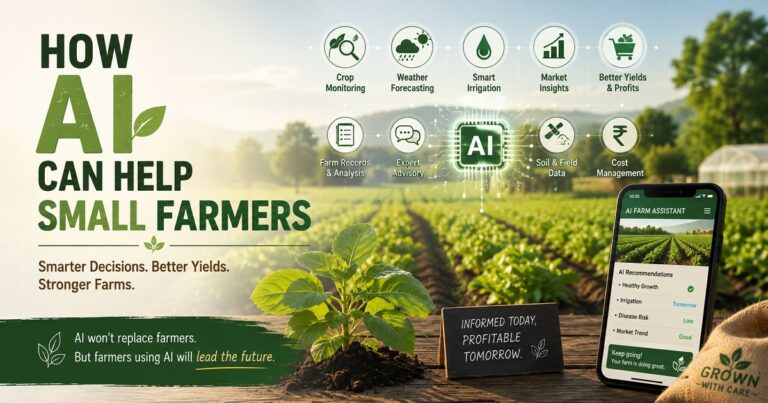
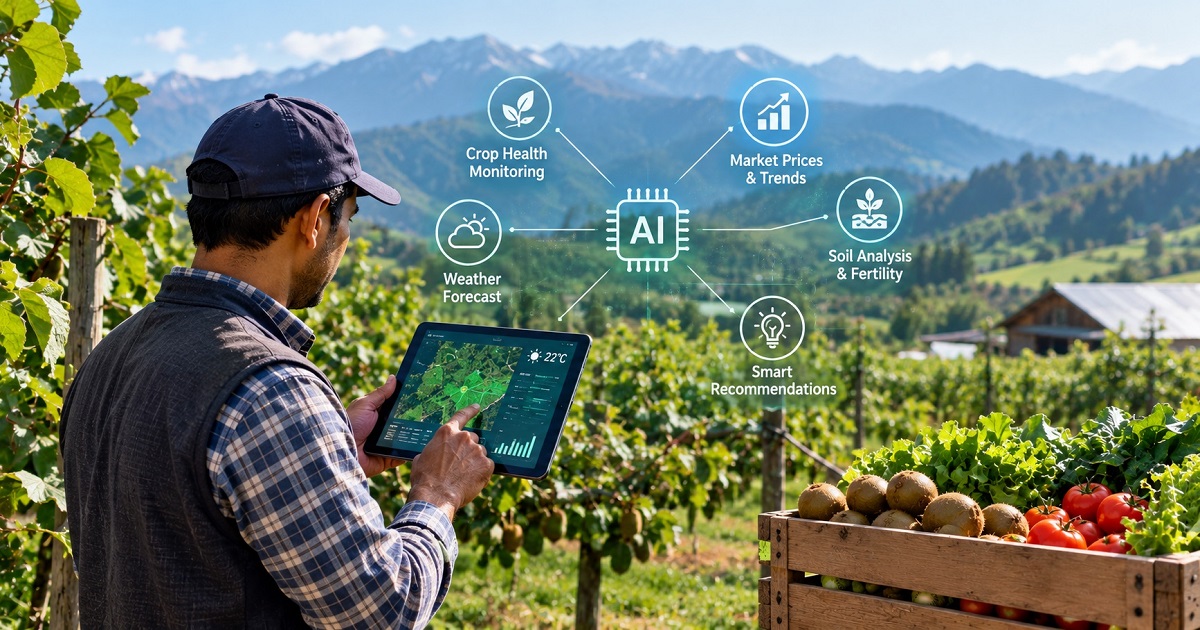
But it can potentially help a farmer process information faster, identify patterns, compare options, communicate with customers, monitor crops and make some decisions with better information.
And this isn’t just a futuristic idea anymore.
AI is already finding its way into agriculture in India and around the world.
The question for farmers is increasingly not:
“Will AI come to agriculture?”
It is:
“How do I use it without losing the judgment and experience that make me a farmer?”
AI in Agriculture Is No Longer a Future Story
A few years ago, talking about AI in farming could easily sound like science fiction.
Today, it is becoming much more practical.
The World Bank’s recent work on AI in agriculture describes applications ranging from farm advice and crop monitoring to risk forecasting, logistics and market-related functions. It also emphasizes that AI is most useful when it turns complicated information into timely, practical advice for farmers.
India is moving in the same direction.
The government’s Digital Agriculture Mission, approved in 2024 with an outlay of ₹2,817 crore, is building digital infrastructure around farmer, land and crop information, including AgriStack and the Krishi Decision Support System. The mission explicitly includes technologies such as artificial intelligence, data analytics and remote sensing.
And the examples are becoming more concrete.
The National Pest Surveillance System uses AI and machine learning for pest detection. According to the Ministry of Agriculture, by July 2026 it was being used by more than 10,000 extension workers and supporting 73 crops and 436 pests.
Bharat-VISTAAR, launched in 2026, is another interesting development. It is designed as a multilingual, voice-first AI platform that can provide farmers with information related to crop management, weather, market prices, pests, diseases and soil health.
These examples are important because they show that AI in agriculture isn’t simply about autonomous tractors or expensive robots.
Sometimes AI can be as simple as a farmer asking a question through a phone.
What I Find Most Interesting About AI for Small Farmers
When people talk about AI, they often imagine large farms.
Huge fields.
Autonomous machinery.
Drones.
Robotic harvesting.
Satellite imagery.
Sophisticated control rooms.
All of that has its place.
But I think one of the biggest opportunities for small farmers could be much simpler.
Access to better information.
A small farmer may not have an agronomist sitting next to the field.
May not have a weather expert.
May not have a marketing analyst.
May not have someone who can analyse years of market data.
May not have a full-time accountant.
May not have a content creator or digital marketer.
AI can potentially help fill some of those gaps.
Not by becoming all of those people.
But by becoming a tool that helps the farmer do more with the resources already available.
The World Bank’s recent examples from India are particularly interesting because they focus on what it calls “small AI”- tools designed to work with basic smartphones and provide practical advice in local languages.
That is much more relevant to the reality of Indian agriculture than the idea that every farmer needs a million-rupee robotic system.
The Farmer Still Makes the Final Decision
This is the part I consider extremely important.
AI should support the farmer’s judgment, not replace it.
Imagine AI tells you that a crop may be showing symptoms of a particular disease.
That information can be useful.
But you still need to look at the crop.
You need to consider the weather.
You need to understand what was applied previously.
You need to know the crop stage.
You need to consider whether the symptoms actually match the local situation.
You may need to consult an agricultural expert.
The AI output is information.
It is not automatically the truth.
The World Bank specifically warns that AI predictions can break down when farms are highly fragmented, local conditions change quickly or field-level data are weak. It recommends that AI outputs support farmer judgment rather than replace it.
That is exactly how I think farmers should approach it.
Don’t ask:
“What does AI tell me to do?”
Ask:
“What does AI suggest, and how does that compare with what I see in my field?”
That is a much healthier relationship with technology.
AI Can Become a Second Pair of Eyes
One of the simplest applications is image-based crop diagnosis.
A farmer can take a photograph of a leaf, fruit or pest and use an AI-enabled system to help identify what might be happening.
This doesn’t mean the AI will always be correct.
But it can provide a starting point.
That can be valuable, especially when a farmer notices something unusual and needs information quickly.
India’s National Pest Surveillance System is an example of this direction. Government information says the system allows images of pests to be captured and uses AI/ML to support identification and timely intervention.
Think about what that changes.
Previously, the process might be:
See problem → take photograph → call someone → wait → explain problem → get advice
With an AI-supported system, it can potentially become:
See problem → photograph it → get an initial assessment → investigate further
That doesn’t eliminate agricultural expertise.
It can make expertise more accessible.
Weather Is Another Area Where AI Can Help
Farmers have always watched the sky.
We’ve looked at clouds, wind, temperature and traditional weather patterns.
But modern farming increasingly involves enormous amounts of weather and climate information.
The challenge isn’t necessarily lack of data.
It is knowing what to do with it.
AI can potentially help turn weather data into more practical decisions.
For example:
- Should I irrigate?
- Should I delay planting?
- Is there a disease risk?
- Is rain likely to affect spraying?
- Should I harvest now?
- Could extreme weather create a risk for the crop?
FAO has highlighted AI’s potential for faster decision-making, pattern detection and climate-related agricultural applications.
And India is already building agricultural digital infrastructure that combines crop, weather, soil and other information.
The Digital Agriculture Mission and Bharat-VISTAAR are examples of this broader shift toward data-driven agricultural decision-making.
AI Could Help With Something Farmers Don’t Talk About Enough: Selling
When people discuss agricultural AI, the conversation usually goes straight to crops.
Pests.
Disease.
Irrigation.
Yield.
But farmers also have another major problem:
selling the produce.
I recently wrote about why selling produce can be harder than growing it.
What if AI could help farmers understand the market side better?
Imagine a farmer being able to ask:
- What are today’s prices in different markets?
- Where is demand stronger?
- What quantity is moving?
- What price trends have occurred recently?
- Which buyers might need this crop?
- How much should I potentially allocate to direct sales?
- Which products could be made from surplus produce?
AI doesn’t magically create a profitable market.
But it can make large amounts of information easier to understand.
That could become particularly important for farmers who traditionally have limited access to market intelligence.
AI Can Help Farmers Become Better Businesspeople
Farming isn’t only about production.
It’s also a business.
And many farm decisions involve information.
Consider a farmer growing tomatoes.
There are decisions about:
- seed
- planting date
- expected yield
- input costs
- labour
- harvesting
- grading
- transportation
- market selection
- pricing
- direct sales
- processing
- wastage
That’s a lot of information for one person to manage.
AI can potentially help organise it.
For example, a farmer could use AI to create a simple farm-costing spreadsheet.
Or analyse expenses.
Or compare expected revenue under different selling scenarios.
Or prepare a crop calendar.
Or create customer messages.
Or translate product information into another language.
Or draft a quotation for a buyer.
None of these tasks sound revolutionary individually.
But together, they can save time.
And for a small farmer, saving time can be valuable.
AI Can Be a Personal Assistant for the Farm
This is probably one of the easiest ways for farmers to start using AI.
Don’t begin with a complicated system.
Start with the work you already do.
For example:
“Here are my expenses for this tomato crop. Organise them into seed, labour, fertilizer, irrigation, transport and other costs.”
Or:
“Here are my last three months of farm sales. Show me which products are selling most frequently.”
Or:
“Create a weekly checklist for my kiwi orchard from flowering to fruit development.”
Or:
“Help me create a simple record format for pest observations.”
Or:
“I have these five vegetables available this week. Help me prepare a customer message for a farm box.”
These aren’t replacing farming.
They’re reducing administrative work around farming.
And that is where I think AI becomes particularly practical.
The Farmer’s Knowledge Becomes More Valuable, Not Less
There is an interesting paradox here.
You might think AI makes farmer knowledge less important.
I think it could actually make good farmer knowledge more valuable.
Why?
Because AI needs context.
Suppose two farmers ask exactly the same question:
“Why are the leaves turning yellow?”
The answer could be completely different depending on:
- crop
- variety
- soil
- irrigation
- weather
- crop stage
- previous applications
- pest pressure
- location
The farmer who knows the field can provide that context.
The farmer who understands agriculture can challenge a bad answer.
The farmer who has years of observation can recognize when something doesn’t make sense.
AI brings information.
Experience brings context.
The combination can be powerful.
This Is Why Farmers Should Not Be Afraid of AI
Technology has always changed agriculture.
The plough changed agriculture.
Irrigation changed agriculture.
Tractors changed agriculture.
Improved seeds changed agriculture.
Drip irrigation changed agriculture.
Mobile phones changed agriculture.
The internet changed agriculture.
AI is another step in that progression.
The farmer who adopted a tractor didn’t stop being a farmer.
The farmer who adopted drip irrigation didn’t stop understanding crops.
Similarly, a farmer who uses AI doesn’t have to become a “technology farmer.”
They are simply using another tool.
The important question is whether the tool actually improves the farm.
But There Is a Big Difference Between Using AI and Trusting AI
This is where farmers need to be careful.
AI systems can make mistakes.
They can misunderstand a question.
They can give generic advice.
They can rely on incomplete information.
They can produce confident-sounding answers that aren’t appropriate for a particular farm.
This is especially important for decisions involving pesticides, fertilizers, livestock health, food safety or major financial investments.
Don’t blindly follow an AI answer because it sounds convincing.
Verify important recommendations with trusted agricultural sources, local experts, extension officers, scientists or experienced practitioners.
AI should make you better informed, not careless.
The Data Problem
There is another issue that doesn’t get enough attention.
AI is only as useful as the information behind it.
A generic AI model may know a lot about agriculture.
But does it know what is happening in your field?
Does it know your soil?
Does it know your microclimate?
Does it know your variety?
Does it know your irrigation system?
Does it know what you applied last week?
Does it know the disease pressure in your particular village?
Not necessarily.
This is why agricultural AI needs good local data.
The World Bank’s research emphasizes the importance of infrastructure, reliable data, local adaptation, skills and institutions that farmers trust.
FAO has similarly emphasized that digital technologies need to be inclusive because many smallholders still face limitations in infrastructure, resources and digital literacy.
So the future isn’t simply:
AI + farmer
It is more like:
Farmer + local data + agricultural knowledge + AI + human expertise
The Digital Divide Is Real
We also shouldn’t pretend every farmer is ready to use AI tomorrow.
Some farmers don’t have reliable internet.
Some aren’t comfortable with smartphones.
Some don’t have access to good agricultural information.
Some may not speak the language used by existing digital tools.
Some may not trust technology.
And some simply don’t have enough time or money to experiment.
FAO has repeatedly highlighted these barriers to digital agriculture adoption among smallholders.
This is why voice-based and multilingual tools are particularly interesting in India.
Bharat-VISTAAR, for example, is being developed as a voice-first and multilingual system rather than assuming that every farmer wants to type complicated questions into an English-language application.
That direction matters.
Technology has to adapt to farmers- not the other way around.
AI Doesn’t Have to Be Expensive
Another misconception is that AI requires expensive hardware.
It doesn’t.
For many farmers, the first AI tool may simply be a smartphone.
A farmer can use AI for:
Planning
Create crop calendars, checklists and farm schedules.
Record keeping
Organise expenses, sales, inventory and customer information.
Communication
Write messages to buyers and customers.
Translation
Communicate across languages.
Marketing
Create product descriptions, social-media posts and simple promotional material.
Research
Summarise agricultural information and compare options.
Analysis
Look at farm records and identify patterns.
Education
Learn about unfamiliar crops, technologies and business models.
These are small applications.
But they can add up.
The Real Advantage May Be Speed
One of AI’s biggest advantages is not intelligence in the abstract.
It is speed.
A farmer may already know how to calculate production costs.
AI can help organise those calculations quickly.
A farmer may already know how to write a customer message.
AI can help draft it in seconds.
A farmer may already know that a pest needs to be investigated.
AI can help identify possibilities quickly.
A farmer may already know the farm needs better records.
AI can help create a structure.
This gives the farmer something increasingly valuable:
time.
And time can be converted into better decisions.
Farmers Who Learn AI May Become More Competitive
This brings me back to the title.
I don’t literally mean that farmers who use ChatGPT or another AI tool are automatically going to replace farmers who don’t.
Agriculture doesn’t work that simply.
But there is a broader competitive principle here.
Imagine two farmers with similar land, similar crops and similar production ability.
One farmer uses technology to:
- track costs
- analyse sales
- monitor weather
- research problems
- communicate with customers
- plan production
- identify market opportunities
- automate routine tasks
The other continues doing everything manually.
Over time, the first farmer may have access to information faster and may spend less time on repetitive work.
That can create a competitive advantage.
And competitive advantages compound.
This is why I think AI literacy may eventually become another farm skill, just like understanding irrigation, soil, markets or machinery.
The Farmer of the Future May Be Both Traditional and Digital
I don’t see a contradiction between traditional agricultural knowledge and modern technology.
In fact, I think the combination could be powerful.
A farmer can understand:
- soil health
- biodiversity
- local weather
- traditional crop knowledge
- natural farming practices
while also using:
- satellite information
- sensors
- weather data
- AI
- digital marketplaces
- farm-management software
It doesn’t have to be tradition versus technology.
It can be:
traditional knowledge + modern information
That is especially relevant to the way I think about farming.
I’ve written previously about why I chose natural farming.
For me, technology doesn’t have to mean moving away from natural or traditional approaches.
Technology can help us understand what is happening more clearly.
The goal should be better decisions, not simply more technology.
AI Can Also Help With Branding and Content
This is an area many farmers may overlook.
If you’re trying to build a farm brand, there is a surprising amount of communication involved.
You need:
- product descriptions
- social-media posts
- customer messages
- packaging copy
- newsletters
- website content
- educational material
- photographs and captions
- answers to customer questions
AI can help with the first draft.
But the farmer still needs to provide the real story.
AI shouldn’t invent your farm story.
You should tell AI what actually happened.
Then let it help you communicate that story more clearly.
This connects with my earlier article on why farmers need branding.
A farm that produces good food but cannot communicate its value may struggle to differentiate itself.
AI can lower the barrier to communication.
AI Could Also Help With Value Addition
Another interesting connection is value addition.
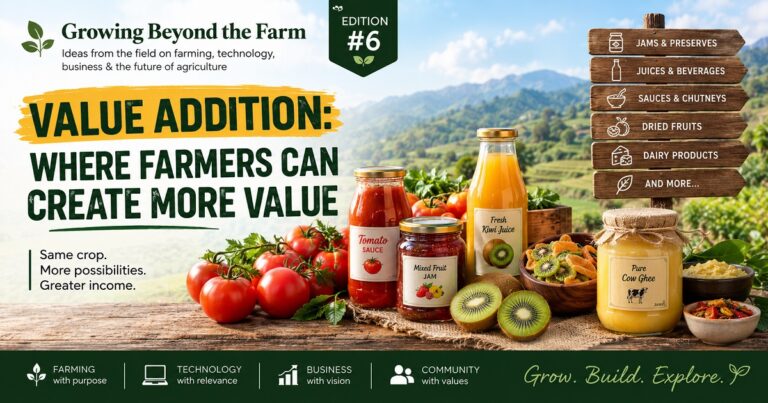
I’ve already written about where farmers can create more value through value addition.
AI can potentially help farmers think through questions such as:
- Which part of my crop is usually wasted?
- Which products could be made from it?
- What equipment might be required?
- What packaging options exist?
- Who could be the target customer?
- What could the approximate unit economics look like?
- What questions should I ask a processor?
- What information should I gather before starting?
Again, AI isn’t going to turn a tomato into a profitable sauce business automatically.
But it can help a farmer explore possibilities faster.
That matters.
The Biggest Opportunity May Be Decision Support
If I had to choose one area where AI could become particularly valuable in agriculture, I would choose decision support.
Farmers make hundreds of decisions.
Some are small.
Some are expensive.
Some are time-sensitive.
AI can potentially help bring more information into those decisions.
But the ideal model isn’t:
AI decides → farmer follows
It is:
AI analyses → farmer evaluates → farmer decides
That distinction keeps human judgment at the centre.
What Should a Farmer Actually Learn?
I don’t think every farmer needs to learn programming.
You don’t need to become a machine-learning engineer.
You don’t need to understand neural networks.
You don’t need to build an AI model.
You need to learn how to use AI as a tool.
I would start with five skills.
1. Learn how to ask better questions
The quality of an AI response depends heavily on the information you provide.
Instead of:
“Why are my tomato leaves yellow?”
Try:
“I am growing tomatoes in Himachal Pradesh at around 4,000 feet. The plants are at this growth stage. The lower leaves are turning yellow while new growth remains green. Irrigation has been regular. What are the possible causes, and what observations should I make before deciding what action to take?”
That’s a much better question.
2. Learn how to verify answers
Don’t blindly trust the output.
Especially for high-stakes agricultural decisions.
3. Learn how to provide context
AI needs information about your farm.
The more relevant context you can provide, the more useful the discussion can become.
4. Learn to work with your own records
Farm records can become extremely valuable when you combine them with analytical tools.
5. Learn where AI should NOT be used
Sometimes the correct answer is:
Call an expert.
Knowing when not to use AI is also an AI skill.
Don’t Start With the Most Complicated AI Tool
If you’re a farmer who hasn’t used AI yet, don’t begin by buying expensive technology.
Start with a problem.
That’s my preferred approach.
Ask:
What is wasting my time?
Maybe it’s writing customer messages.
Start there.
Maybe it’s organising expenses.
Start there.
Maybe it’s understanding weather information.
Start there.
Maybe it’s creating marketing content.
Start there.
Maybe it’s learning about a crop disease.
Start there- but verify the answer.
Once one use case becomes useful, move to another.
That’s much better than adopting technology simply because everyone is talking about it.
What I Think Will Happen Next
I don’t think the biggest agricultural AI revolution will necessarily arrive as one giant invention.
It may happen through hundreds of small improvements.
A farmer gets better weather information.
Another gets faster pest identification.
Someone else uses AI to analyse farm costs.
Another farmer finds customers through digital channels.
An FPO uses data to coordinate supply.
A buyer uses AI to forecast demand.
A processor uses data to manage raw-material procurement.
A government system connects weather, crop and market information.
Each improvement may seem small.
Together, they can change how agricultural decisions are made.
The World Bank’s recent work in India reflects this direction: AI tools are increasingly being designed around practical problems faced by smallholders rather than only around large-scale automation.
But We Should Be Careful About the Hype
I am optimistic about AI in agriculture.
But I’m not interested in AI hype.
AI isn’t going to solve:
- poor roads
- unreliable electricity
- weak cold chains
- lack of storage
- poor market access
- fragmented landholdings
- low farm income
- bad agricultural policy
- inadequate extension services
with a chatbot.
Technology can help.
But agriculture is a physical business.
Seeds have to grow.
Water has to reach the field.
Harvest has to be collected.
Produce has to move.
Customers have to pay.
AI cannot change those realities by itself.
The World Bank explicitly describes AI as dependent on infrastructure, governance, skills, reliable data and inclusion.
That is an important reality check.
The Farmers Who Adapt Will Have More Tools
This is ultimately how I see it.
The future farmer doesn’t have to choose between:
farmer OR technology
It can be:
farmer + technology
A farmer with experience can use AI.
A natural farmer can use AI.
A small farmer can use AI.
A young farmer can use AI.
An experienced farmer can use AI.
An FPO can use AI.
A farm business can use AI.
The technology doesn’t remove the identity of the farmer.
It expands the farmer’s toolkit.
And perhaps that’s the most important way to think about it.
Final Thoughts
AI won’t replace the farmer who understands the land.
It won’t know your field better simply because it has access to more information.
It won’t experience your weather.
It won’t see your crop exactly the way you do.
It won’t understand your customers the way you do unless you teach it.
And it won’t take responsibility for the final decision.
But AI can help a farmer see more, analyse faster, learn quicker and communicate better.
That can matter enormously.
The competitive advantage may not belong to the farmer who uses the most technology.
It may belong to the farmer who knows where technology is useful and where human judgment matters more.
For me, that’s the exciting part.
I don’t want technology to replace the farmer.
I want technology to help the farmer become better informed, more efficient and more capable of making good decisions.
Because farming has always required adaptation.
The tools have changed.
The land hasn’t.
And the farmer is still the one who has to make the final call.
AI may not replace farmers. But farmers who learn to use AI may have an advantage over those who choose not to.
That, to me, is a much more realistic and much more exciting future for agriculture.