Why Selling Farm Produce Is Harder Than Growing It
There is something strange about farming.
When we talk about farming, most of the attention goes to production.
How much did you grow?
How many acres did you cultivate?
What variety did you plant?
What was the yield?
How much fertilizer did you use?
How did you control pests?
These are all important questions. But there is another question that can determine whether all that effort actually becomes a good business:
How are you going to sell it?
This is something I have increasingly come to think about as a farmer and kiwi grower. Growing a crop and selling a crop are two very different businesses. One happens in the field. The other happens after the harvest-and often involves customers, timing, quality, packaging, transportation, negotiation, market information, relationships and sometimes a lot of uncertainty.
A farmer can do almost everything right during production and still struggle to make a good return.
The crop can be healthy.
The yield can be good.
The quality can be excellent.
And then the farmer reaches the market and discovers that producing the crop was only half the job.
The other half is finding someone who values it.
The Harvest Is Not the End
I used to think about farming primarily from the production side.
You prepare the land.
You select the crop.
You plant.
You manage it.
You protect it.
You harvest.
But the harvest isn’t really the end of the farming business.
In many ways, it is the beginning of another business.
Once produce is harvested, the clock starts running.
A tomato doesn’t wait for the farmer to find the best buyer.
A ripe peach doesn’t care whether the market price is good tomorrow.
A box of fresh vegetables doesn’t become more valuable simply because the farmer worked harder to grow it.
The farmer now has to answer a completely different set of questions:
- Who will buy it?
- How much do they need?
- When do they need it?
- What quality do they expect?
- What size or grade do they want?
- How should it be packed?
- How far does it need to travel?
- Who will pay for transportation?
- How quickly will the payment come?
- What happens to the produce that doesn’t meet the buyer’s specifications?
- What happens if the market price falls?
- Can the farmer sell directly instead?
- Can some of the crop be processed?
- Can the customer be reached before harvesting?
These questions have very little to do with growing the crop.
They have everything to do with marketing.
And that is why I believe selling produce can sometimes be harder than growing it.
A Good Crop Does Not Automatically Mean a Good Price
One of the biggest lessons in agriculture is that production and profitability are not the same thing.
A farmer can increase production and still struggle financially.
Imagine two farmers growing the same crop.
Both produce 1,000 kg.
One farmer sells everything immediately to the nearest available buyer.
The other has information about several buyers, understands different quality requirements, grades the produce, packs it properly and has already developed relationships with customers.
They produced the same amount.
But their businesses may look completely different.
This is why I increasingly believe farmers need to think beyond “How much can I grow?”
The better question is:
“How much value can I create from what I grow?”
That shift in thinking changes everything.
And it connects directly with something I wrote about in my earlier article on value addition in agriculture.
Value doesn’t necessarily begin inside a processing factory.
Sometimes it begins with better harvesting, sorting, grading, packaging, timing and understanding the customer.
The Farmer Often Knows the Crop Better Than the Customer
There is another challenge.
Farmers spend months understanding their crop.
They know when it was planted.
They know what weather it experienced.
They know what problems occurred during the season.
They know when it was harvested.
They know its growing conditions.
But the customer usually doesn’t see any of that.
The customer sees a product.
A tomato.
A box of kiwi.
A bunch of beans.
A basket of peaches.
A packet of dried fruit.
The customer doesn’t automatically pay more because producing it was difficult.
The customer pays when they see value.
That value might be:
- better taste
- freshness
- consistency
- appearance
- convenience
- reliable delivery
- attractive packaging
- traceability
- trust
- a known brand
- a particular variety
- a specific quality
- a story they connect with
This is where farming starts becoming a customer business.
And farmers aren’t traditionally trained for that.
We learn how to grow crops.
We don’t always learn how to build markets for them.
The Market Doesn’t Know How Hard You Worked
This is probably one of the hardest realities for farmers to accept.
The market doesn’t necessarily reward effort.
It rewards value perceived by the buyer.
You might spend months taking care of a crop.
You might wake up early, work through bad weather and deal with pests, irrigation problems and unpredictable conditions.
But when the produce reaches the market, the buyer may simply say:
“This is today’s rate.”
That can feel frustrating.
But there is an important lesson hidden inside it.
If the farmer is completely dependent on the market that exists at harvest time, the farmer has very little control.
The more control you can create over who buys, how they buy and what they value, the stronger your position becomes.
This doesn’t mean eliminating mandis, traders or wholesalers.
They are important parts of India’s agricultural ecosystem.
It means farmers should have more than one route to market whenever the economics make sense.
Selling Through the Mandi Is Not Necessarily the Problem
It is easy to turn this discussion into “farmers should stop selling through mandis.”
I don’t think that’s the right conclusion.
Mandis exist for a reason.
They aggregate large quantities of produce and connect farmers with buyers. They provide an established trading system and can be especially important when a farmer needs to move a large quantity quickly.
India has also been working to improve agricultural market access through systems such as e-NAM. The National Agriculture Market connects participating APMC markets through an electronic trading platform, with the stated goals of improving price discovery, reducing information asymmetry and facilitating wider market access.
As of June 30, 2026, the government reported 1.89 crore farmers and 2.78 lakh traders registered on e-NAM.
So the problem isn’t simply:
“Mandi = bad.”
The bigger problem is having only one selling option.
A farmer should ideally understand several possibilities:
Mandi → wholesaler → retailer → processor → institutional buyer → FPO/FPC → direct consumer → online/direct orders
The appropriate channel depends on the crop, quantity, location, perishability, quality and economics.
Perishable Produce Makes Selling Even Harder
For crops such as tomatoes, peaches, leafy vegetables and many other fresh products, the farmer has another enemy:
time.
A farmer can sometimes store wheat or pulses and wait for a better opportunity.
Fresh produce is different.
Quality can deteriorate rapidly.
This creates a strange imbalance.
The farmer may need to sell today, while the buyer knows the farmer needs to sell today.
That weakens bargaining power.
Post-harvest losses make this even more important. A 2025 government release based on the NABCONS study reported estimated losses of 6.02–15.05% for fruits and 4.87–11.61% for vegetables, depending on the crop and stage of the supply chain.
Another government release reported that the study estimated 7.36 million tonnes of fruit and 11.97 million tonnes of vegetables lost across the assessed system.
These aren’t simply production problems.
They are also marketing, logistics, storage, handling and infrastructure problems.
The crop has already been grown.
The opportunity is being lost after harvest.
Sometimes the Farmer Is Not Losing Money in the Field
This is an important distinction.
Suppose a farmer grows excellent produce.
If the produce is damaged during transportation, that’s a loss.
If it cannot be stored for two days and prices crash, that’s a loss.
If it is mixed with lower-quality produce and receives a lower price, that’s a loss.
If poor packaging causes damage, that’s a loss.
If the farmer has no information about demand and harvests at the wrong time, that’s a loss.
If the farmer cannot reach a better-paying buyer because the quantity is too small, that’s a market-access problem.
In other words:
The economics of farming don’t stop at the farm gate.
The government itself has recognized the importance of post-harvest infrastructure. The Agricultural Infrastructure Fund is intended to support storage, cold stores, sorting, grading, ripening and other infrastructure so farmers can preserve produce and potentially access better markets and price realization.
Quality Is Not Just About Growing
Farmers often think about quality as something created in the field.
That is only part of the story.
Suppose I grow excellent tomatoes.
If I throw them into a damaged crate, transport them badly and deliver bruised fruit to a customer, the customer doesn’t experience the quality I created.
The final product is what the customer receives.
That means quality continues after harvest.
Harvest timing matters.
Handling matters.
Sorting matters.
Grading matters.
Packaging matters.
Temperature matters.
Transportation matters.
Delivery timing matters.
Communication matters.
This is why the farmer who wants to sell directly needs to start thinking like a producer and a supply-chain manager.
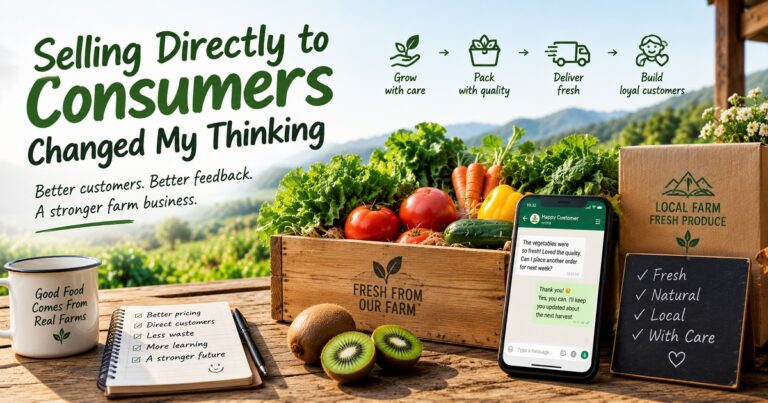
Selling Directly Changes the Questions
I have written before about how selling directly to consumers changed my thinking.
One of the biggest changes is that you stop thinking only about the crop.
You start thinking about the person who will actually eat it.
A traditional production mindset might ask:
How much can I produce?
A direct-selling mindset asks:
What does the customer actually want?
Those are very different questions.
A customer might not want 20 kg of tomatoes.
They might want a weekly vegetable box.
They might want 2 kg of tomatoes with 1 kg of beans and some capsicum.
A restaurant might want consistent size and delivery twice a week.
A retailer might want attractive packaging.
A processor might want large quantities of a particular grade.
An individual consumer might care more about freshness and trust.
The same crop can therefore have different value for different buyers.
Finding that difference is part of marketing.
Farmers Need to Know Their Buyer
One of the biggest mistakes a farmer can make is producing first and asking who will buy it later.
Sometimes that is unavoidable.
Agriculture is unpredictable.
But whenever possible, I think the process should move in the opposite direction.
Start with the buyer.
Then work backwards.
For example:
Buyer: Restaurant
What does the restaurant need?
- consistent supply
- predictable quality
- specific sizes
- reliable delivery
- invoices
- predictable pricing
That is a completely different business from selling one truckload to a wholesale buyer.
Or:
Buyer: Consumer
The customer may care about:
- freshness
- convenience
- appearance
- packaging
- delivery
- trust
- story
- easy ordering
Again, different business.
Or:
Buyer: Processor
The processor might care about:
- volume
- consistency
- maturity
- variety
- price
- delivery schedule
The crop hasn’t changed.
The customer has.
And therefore the selling strategy changes.
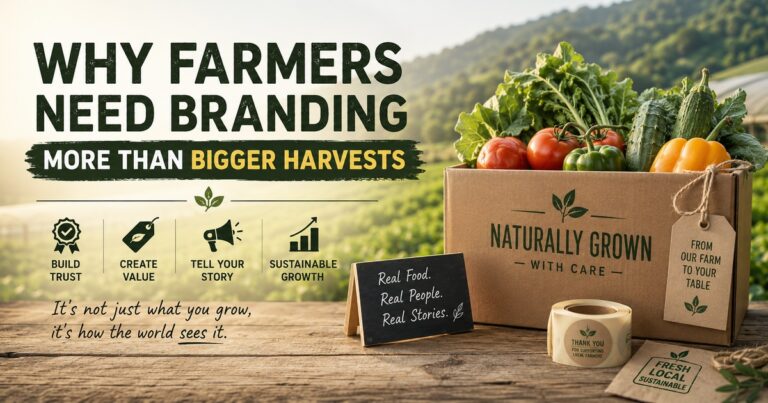
Branding Becomes Important
This is where marketing and branding enter agriculture.
I wrote earlier about why farmers need branding.
Branding isn’t simply putting a logo on a box.
It is about giving the customer a reason to recognize, remember and trust your product.
Imagine two boxes of similar-looking fruit.
One simply says:
KIWI – ₹___/kg
The other communicates:
Mountain-grown kiwi from Himachal Pradesh
Carefully selected and packed
Farm source identified
The second product is giving the customer more information.
That doesn’t automatically mean the customer will pay more.
But it creates an opportunity to differentiate.
And differentiation becomes increasingly important when farmers are selling products that otherwise look like commodities.
Value Addition Can Make Selling Easier
Sometimes the solution isn’t to sell the raw crop at all.
This is where value addition becomes interesting.
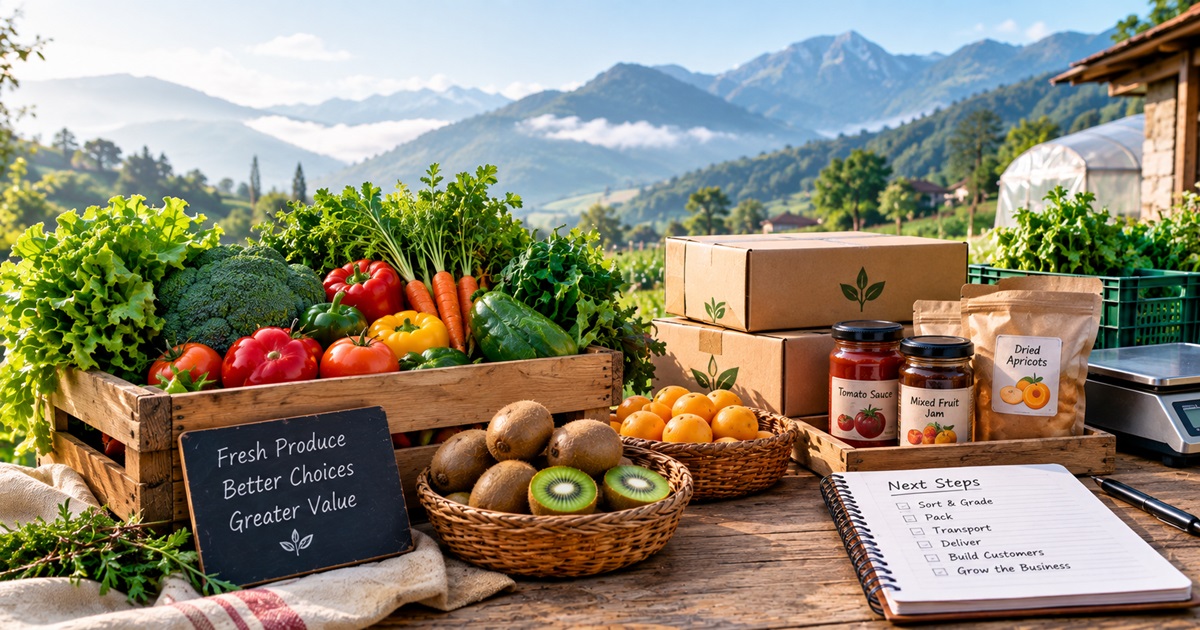
A farmer growing apricots could potentially sell:
- fresh apricots
- dried apricots
- jam
- preserves
- gift packs
Tomatoes could potentially become:
- fresh tomatoes
- puree
- sauce
- dried tomatoes
- other processed products
Fruit can potentially become:
- juice
- pulp
- jam
- dried fruit
- other processed products
The important point is not that every farmer should start a processing unit.
The point is that the form in which you sell the crop can change its market.
India already has a significant processed-food export ecosystem. APEDA reports that India exported about 527,116 tonnes of processed fruits, juices and nuts worth $662.79 million in FY 2025–26.
That doesn’t mean a small farmer should immediately think about exporting.
But it demonstrates something important:
Agricultural products don’t have to remain agricultural commodities.
They can become food products.
And food products can have very different markets.
But Processing Is Not Automatically More Profitable
This is another trap.
It is easy to say:
“Instead of selling tomatoes for ₹20/kg, I’ll make sauce and sell it for ₹200/kg.”
That calculation is incomplete.
The ₹200 product may involve:
- processing
- ingredients
- labour
- electricity
- packaging
- labels
- testing
- storage
- wastage
- transportation
- marketing
- distributor margins
- retailer margins
- returns
- compliance
- working capital
The selling price is not the profit.
This is why value addition has to be approached as a business, not just as a way to increase the price per kilogram.
The Real Equation Is Net Realization
I prefer to think about the final amount that reaches the farmer.
A simple way to think about it is:
Net realization = Selling price − all costs required to reach that sale
Those costs can include:
- harvesting
- sorting
- grading
- packaging
- transportation
- storage
- processing
- commissions
- platform fees
- labour
- wastage
- returns
- marketing
Sometimes selling directly at a higher price gives a better margin.
Sometimes the extra work isn’t worth it.
Sometimes selling through an established buyer is actually the better business decision.
The objective shouldn’t be:
“Sell for the highest price.”
It should be:
“Create the best sustainable net realization for the effort and risk involved.”
Small Farmers Have One Advantage
There is one area where I think small farmers can potentially compete very well.
Relationships.
A large commodity business is designed around volume and efficiency.
A small farm can sometimes compete through:
- personal connection
- transparency
- farm stories
- freshness
- specialty products
- local identity
- niche varieties
- customer communication
- flexibility
- small batches
- customization
A farmer doesn’t necessarily need thousands of customers.
A smaller number of repeat customers who trust the farm can be extremely valuable.
But that requires treating customers as relationships rather than transactions.
Repeat Customers Are More Valuable Than Constantly Finding New Customers
Imagine you sell 100 boxes of produce.
After the sale, you start again from zero.
Next week you need another 100 buyers.
That is exhausting.
Now imagine a portion of those customers return every week.
Your marketing problem becomes much smaller.
This is why direct selling isn’t just about finding buyers.
It is about creating repeat demand.
And repeat demand comes from consistency.
The customer needs to know:
- the product will arrive when promised
- quality will be reasonably consistent
- communication will be clear
- problems will be handled
- ordering will be easy
The farmer is no longer simply selling vegetables.
The farmer is providing a service.
Technology Can Help, But It Doesn’t Solve Everything
Technology can make selling easier.
A farmer can use relatively simple tools for:
- taking orders
- maintaining customer lists
- tracking inventory
- recording payments
- managing delivery routes
- sending updates
- collecting feedback
- analysing sales
- monitoring repeat purchases
More advanced systems can eventually help with demand forecasting, pricing analysis and supply planning.
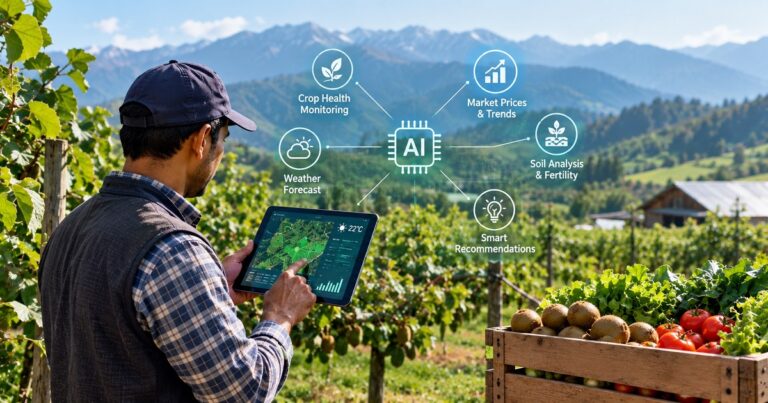
I’ve also written about how AI can help small farmers.
But I don’t think technology should be viewed as the solution to every agricultural problem.
If you don’t know your customer, an AI tool won’t magically create a market.
If your produce is inconsistent, a website won’t fix the quality problem.
If your logistics are unreliable, social media won’t solve delivery.
Technology works best when it is applied to a real business process.
Farmers Should Think in Terms of Multiple Markets
One of the safest approaches, in my opinion, is not to depend entirely on one buyer or one channel.
A farm could potentially have several routes:
Market 1: Wholesale
Useful for moving larger quantities quickly.
Market 2: Retailers
Potentially better margins, but usually more requirements around consistency and delivery.
Market 3: Restaurants and institutions
Can provide repeat demand if specifications and supply are reliable.
Market 4: Direct consumers
Potentially higher realization, but requires more work in customer acquisition, packing and delivery.
Market 5: Processing
Useful for surplus, lower grades or seasonal production, depending on economics and food-safety requirements.
Market 6: FPO/FPC aggregation
Small farmers can combine volumes and potentially reach buyers that would otherwise be difficult to serve individually.
This is one reason farmer organizations can be important.
A farmer with 100 kg may struggle to attract a large buyer.
100 farmers with 10 tonnes can become a completely different proposition.
Aggregation Can Change the Equation
This is particularly important for small and marginal farmers.
The problem is often not that the produce doesn’t have a market.
The problem is that the individual farmer doesn’t have enough quantity to serve that market efficiently.
Aggregation can solve part of this.
But aggregation isn’t just about putting everyone’s produce into one truck.
It requires:
- consistent quality
- agreed grading
- collection points
- records
- scheduling
- packaging
- logistics
- buyer relationships
- payment systems
- trust among members
Done properly, it can turn fragmented production into a commercially meaningful supply.
e-NAM itself supports registration of FPOs/FPCs and provides mechanisms for market participation and logistics support.
The Farmer Has to Learn a New Skill: Negotiation
Growing skills and selling skills are different.
A good farmer can understand crop health.
A good seller has to understand the buyer.
That means learning to ask:
- What quantity do you need?
- What grade?
- What size?
- How often?
- What packaging?
- Where should it be delivered?
- What is your payment cycle?
- What happens with rejected produce?
- What volume can you commit to?
- What price structure works for both sides?
These questions may feel uncomfortable at first.
But they are part of running an agricultural business.
The farmer doesn’t have to become an aggressive salesperson.
The farmer needs to become a better businessperson.
Selling Should Start Before Harvest
This may be one of the most important changes farmers can make.
Don’t wait until everything is harvested before thinking about selling.
Start earlier.
If you know that your crop will be ready in three weeks, start talking to buyers now.
If you’re growing a specialty variety, find out whether there is demand before planting large quantities.
If you want to sell directly, start building your customer base before harvest.
If you want to supply restaurants, speak to them before the season begins.
If you want to process part of the crop, investigate processing options before the harvest arrives.
The earlier the market conversation starts, the less pressure there is after harvesting.
Production Planning Should Include the Market
This is where I think the future of farming becomes particularly interesting.
Instead of:
Produce → harvest → search for buyer
we should gradually move toward:
Understand demand → plan production → grow → harvest → sort → sell through the right channel
That’s a very different mindset.
It is closer to how other businesses operate.
A farmer still has to deal with weather and biological uncertainty, of course.
But the business can become more market-oriented.
And this doesn’t mean abandoning traditional farming knowledge.
It means combining it with business knowledge.
Farming Needs More Than Better Production
I’ve written before about why I still believe farming can be one of the best businesses in India. The opportunity is real, but I increasingly think the biggest opportunities aren’t necessarily going to come from simply producing more of the same commodity.
They will come from farmers who can connect:
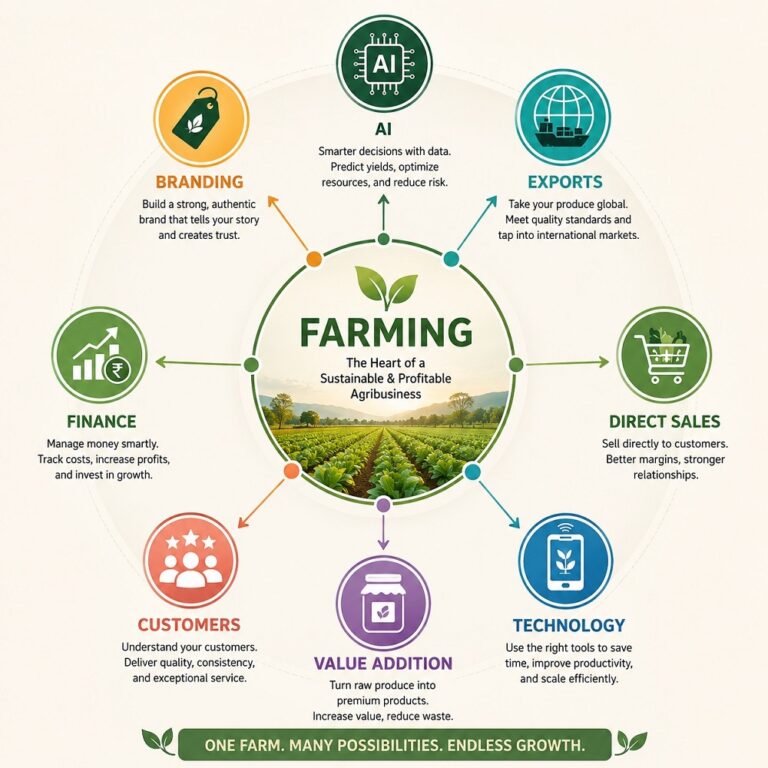
Production + Quality + Marketing + Branding + Value Addition + Technology + Customer Relationships
That’s a much bigger skill set.
And it doesn’t mean every farmer needs to master all of these alone.
Farmers can work with FPOs, processors, logistics companies, retailers, technology providers and other partners.
The important thing is understanding where value is being created, and where it is being lost.
If I Were Starting Again, I Would Think About the Buyer Earlier
If I were starting a new farm enterprise today, I would ask some questions before putting the crop in the ground.
Who is going to buy this?
Why will they buy it from me?
What quality do they want?
How much are they likely to buy?
When do they need it?
How far away are they?
What will it cost to get the product there?
What will happen if the price falls?
Can I store it?
Can I process some of it?
Can I sell directly?
Can I aggregate with other farmers?
What part of the crop could become a higher-value product?
These questions don’t guarantee success.
But they can prevent one of the biggest mistakes in farming:
growing something first and figuring out how to sell it later.
The Future Farmer May Need to Be a Marketer Too
I don’t think farmers need to become influencers.
They don’t need to spend their entire day on social media.
They don’t all need fancy websites.
But I do think farmers increasingly need to understand marketing.
Marketing, at its simplest, is understanding:
Who wants what I produce, why do they want it, and how can I reliably get it to them?
That is not separate from farming.
It is part of the agricultural business.
And once you start looking at farming this way, many things begin to make more sense.
Packaging is marketing.
Quality grading is marketing.
A reliable delivery schedule is marketing.
A recognizable farm name is marketing.
Customer feedback is marketing.
A good photograph of your produce is marketing.
A repeat customer is marketing.
Even the decision about what variety to grow can be a marketing decision.
The Biggest Shift Is From Product Thinking to Customer Thinking
This may be the biggest lesson I have taken from thinking about direct selling and value addition.
A farmer naturally starts with the product.
I grow kiwi.
I grow tomatoes.
I grow vegetables.
But the customer doesn’t necessarily care about the product alone.
They care about what the product does for them.
They want something fresh.
Something convenient.
Something trustworthy.
Something tasty.
Something that fits their needs.
Something they can depend on.
So perhaps the better question isn’t:
“What can I grow?”
It is:
“What can I grow that someone actually wants, and how can I deliver it better than the alternatives?”
That is a much harder question.
But it is also a much more valuable one.
Selling Produce Is Hard, But That Is Also the Opportunity
The difficulty of selling agricultural produce shouldn’t discourage farmers.
It should make us pay more attention to the business side of farming.
There is a huge opportunity between the farm gate and the final customer.
Better post-harvest handling can reduce losses.
Better grading can create differentiation.
Better packaging can protect quality.
Better market information can improve decisions.
Better logistics can expand the customer base.
Better branding can build trust.
Value addition can create new products.
Direct selling can create customer relationships.
Aggregation can create scale.
Technology can connect many of these pieces.
Government programs are also increasingly focused on reducing post-harvest losses and improving infrastructure. The PMKSY framework, for example, includes integrated processing and preservation infrastructure, cold chain and value-addition infrastructure, and food-safety and quality systems.
The opportunity, therefore, isn’t simply to become a better producer.
It is to become a better agricultural business.
Final Thoughts
Growing a crop is difficult.
But at least in the field, the farmer has a reasonable degree of control.
You can observe the crop.
You can manage irrigation.
You can improve soil.
You can monitor pests.
You can make decisions.
Once the produce leaves the farm, the environment becomes much more complicated.
You are dealing with buyers, prices, demand, competition, transportation, quality expectations, timing and customer behaviour.
That is why selling produce can sometimes be harder than growing it.
But perhaps the answer isn’t to avoid the market.
It is to understand it better.
Farmers don’t have to control every part of the supply chain.
They don’t have to sell everything directly.
They don’t have to build processing factories.
They don’t have to become marketers overnight.
But they should understand what happens to their produce after harvest.
Where does the value go?
Who captures it?
Where is value being lost?
And most importantly:
What can I do differently so that more of the value created by my farm comes back to the farm?
For me, that is becoming one of the most interesting questions in agriculture.
Because perhaps the next big opportunity for farmers isn’t simply growing more.
It is learning how to sell better, build better products and keep more of the value they create.