Value Addition: Where Farmers Can Create More Value
Farming teaches you something very quickly: producing more does not always mean earning more.
A farmer can work harder, increase production, improve quality and still find that the final income is not very different.
The reason is simple.
A large part of the value of agricultural produce is often created after it leaves the farm.
A tomato is sold as a tomato. A mango is sold as a mango. A kilogram of apricots is sold as a kilogram of apricots. A farmer may have spent months producing it, but someone else may earn considerably more by processing, packaging, branding, distributing or selling the same agricultural product in a different form.
This is why I have increasingly started thinking about farming not only as production, but as a business of creating value.
For me, this is particularly interesting because I grow and work with crops such as kiwi, vegetables and fruits in Himachal Pradesh. Living close to the farm makes it easier to see both sides of the equation: the effort involved in growing something and the opportunities that exist once that produce is harvested.
I don’t think every farmer needs to become a food-processing company.
But I do believe more farmers should ask:
“What else can I do with what I grow?”
That question can change the economics of farming.
Growing More Is Not Always the Answer
For a long time, the obvious way to increase farm income seemed to be straightforward:
Grow more.
More land.
More plants.
More production.
Higher yields.
There is certainly nothing wrong with improving productivity. In fact, productivity remains fundamental to a successful farm.
But there is a limit to this approach.
Suppose a farmer produces 1,000 kg of tomatoes and sells them at ₹20 per kg.
The gross value is ₹20,000.
Now imagine another business buying those tomatoes and turning them into a branded tomato sauce.
The final product might contain tomatoes, spices, packaging, processing, labour, marketing and distribution. The consumer is no longer simply buying a kilogram of tomatoes.
They are buying convenience, taste, consistency, packaging, shelf life and a brand.
The tomato hasn’t necessarily become more valuable because it was grown differently.
It became more valuable because something was done with it.
That distinction is important.
The farmer’s opportunity is not always to produce more raw material.
Sometimes it is to participate in more stages of the value chain.
What Exactly Is Value Addition?
Value addition sounds like a complicated business term, but the basic idea is quite simple.
You take an agricultural product and do something that makes it more useful, convenient, durable, attractive or desirable to the customer.
That could involve:
- Processing
- Drying
- Grading
- Sorting
- Packaging
- Branding
- Preservation
- Cooking
- Extracting
- Fermenting
- Milling
- Combining ingredients
- Improving shelf life
- Creating a ready-to-use product
Not all of these activities create the same level of value, and some are more accurately described as post-harvest handling rather than processing.
But the underlying principle is the same:
Don’t always sell the farm output in its least valuable form.
For example:
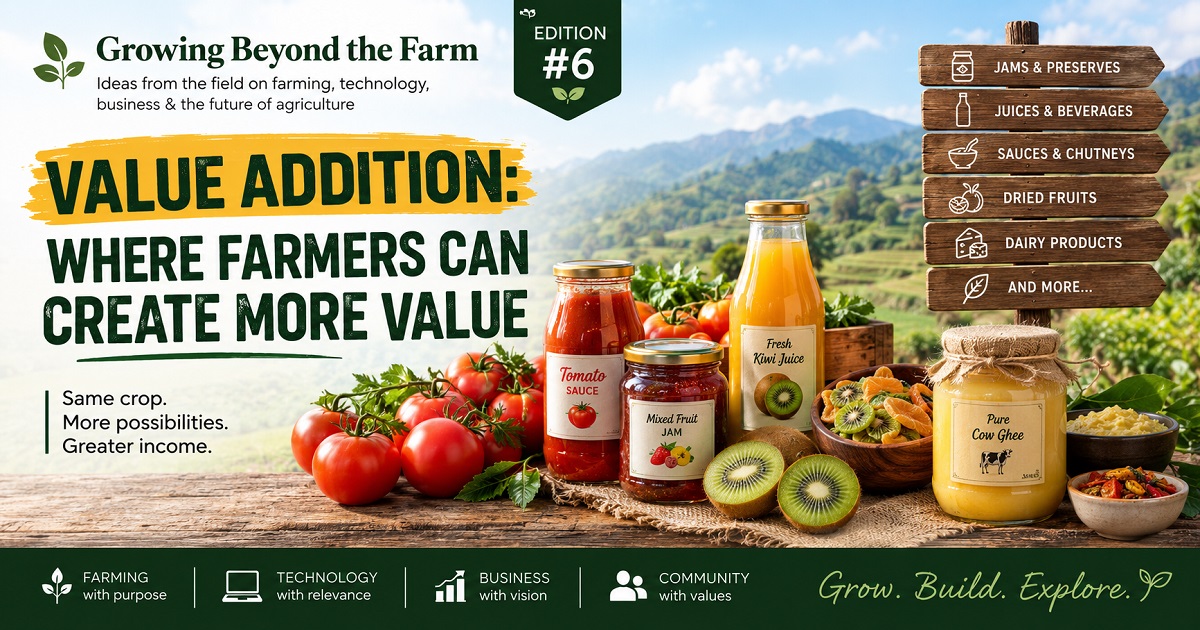
Tomato → tomato sauce
Mango → pulp → juice → branded beverage
Apricot → dried apricot
Milk → ghee, paneer, yoghurt or other dairy products
Fruit → jam, jelly or juice
Garlic → cleaned, dried, flakes or powder
Wheat → flour → packaged branded flour
Honey → filtered, tested, packaged and branded honey
The possibilities are much larger than they first appear.
And this is not just a theoretical opportunity.
India already has a substantial processed-food industry and exports processed vegetables, fruits, juices, nuts, pulses and many other value-added products. APEDA’s current data shows processed food exports running into billions of dollars, while processed fruits, juices and nuts alone accounted for about US$663 million of exports in FY2025-26.
So the market exists.
The bigger question is:
How much of that value can farmers capture?
A Farmer Should Not Think Only in Terms of Crops
One change in thinking that I find particularly useful is this:
Instead of asking:
“Which crop should I grow?”
we should sometimes ask:
“Which product should I sell?”
These are very different questions.
If I ask which crop to grow, I might compare kiwi, tomato, capsicum, beans or garlic based on production, climate, price and market demand.
But if I ask which product to sell, the possibilities become much wider.
Kiwi isn’t necessarily just fresh kiwi.
It could potentially become:
- Premium packed kiwi
- Dried kiwi
- Kiwi-based products
- Kiwi beverages
- Jam or preserves
- Gift boxes
- Processed food ingredients
The same thinking applies to many other crops.
This doesn’t mean every farmer should immediately start manufacturing products.
It means we should start looking at agriculture from the customer’s perspective.
The customer doesn’t necessarily care how many kilograms you harvested.
The customer cares about what problem your product solves.
My Thinking Has Changed Because of Farming
One reason I find this subject interesting is that farming has changed the way I think about business.
When you are close to agriculture, you begin to realise that producing something is only one part of the journey.
You can grow a good crop and still struggle to make a good return.
You can have excellent produce and still not have a market.
You can have demand and still lose money because of transportation.
You can get a good price but lose part of the crop because it is perishable.
And you can have a product that people are willing to pay more for but fail to communicate why it is worth more.
This is why I don’t see value addition as simply “processing food.”
I see it as capturing more of the value created around the crop.
That value can come from processing.
It can come from better packaging.
It can come from branding.
It can come from convenience.
It can come from traceability.
It can come from storytelling.
It can come from creating a product that customers can recognise and remember.
Fresh Produce Is Often the Beginning, Not the End
Take a simple example: apricots.
Fresh apricots are highly perishable. Their value depends heavily on timing, quality and the ability to get them to consumers quickly.
But drying changes the equation.
The product has a longer shelf life, becomes easier to transport and can be sold beyond the short fresh-fruit season.
Dried apricots are also a recognised processed-food category in India’s export ecosystem.
This is one of the things I find fascinating about value addition.
The farmer isn’t necessarily creating a completely new crop.
The farmer is changing the characteristics of the product so that it can travel through a different market.
The same principle can apply to vegetables.
Fresh garlic has one market.
Cleaned and graded garlic has another level of convenience.
Dried garlic flakes or garlic powder can enter another market altogether.
A farmer who only sees garlic as a crop may miss these opportunities.
A farmer who sees garlic as a raw material may see a business.
Tomato Is a Perfect Example
Tomato is another crop that demonstrates the problem very clearly.
During periods of high production, prices can fall dramatically.
The farmer cannot simply tell the tomato plant to stop producing.
At the same time, consumers continue buying tomato products throughout the year.
So there is an interesting mismatch:
The farm produces seasonally, but the consumer market operates continuously.
Processing can help bridge that gap.
Tomatoes can become:
- Sauce
- Puree
- Juice
- Paste
- Pickle
- Dehydrated tomato
- Powder
- Ready-to-use cooking products
APEDA’s processed-food categories include tomato juice and prepared or preserved tomatoes, among other processed fruit and vegetable products.
This is where value addition can become particularly powerful.
Instead of asking only:
“What is today’s tomato price?”
the business can potentially ask:
“What products can we make from tomatoes, and which customers will buy them?”
That is a much bigger business question.
Value Addition Can Also Reduce Dependence on One Market
One of the biggest risks in agriculture is dependence.
Dependence on one crop.
Dependence on one buyer.
Dependence on one mandi.
Dependence on one season.
Dependence on one price.
Value addition can create additional routes to market.
Imagine a farmer producing tomatoes.
The farmer could potentially have several channels:
Fresh tomatoes → local retailers
Premium tomatoes → direct consumers
Grade B tomatoes → processing
Processed tomato product → retail/online
Instead of everything depending on the fresh market on one particular day, the business has more options.
This doesn’t eliminate risk.
But it can distribute it.
And I think that is an important distinction.
Value addition becomes even more powerful when farmers stop thinking only about production and start thinking about branding their farm produce.
The “Lower Grade” Produce May Still Have Value
There is another part of value addition that deserves more attention.
Not every fruit or vegetable meets the visual standards of premium fresh retail.
Maybe the kiwi is slightly smaller.
Maybe the tomato is not perfectly shaped.
Maybe the apricot has a minor cosmetic imperfection.
That doesn’t automatically mean the product has no value.
The fresh market may reject it or pay less for it.
But another product may be able to use it.
This is where processing can help turn part of what might otherwise become waste into another revenue stream.
Of course, food safety and quality requirements still matter. Processing is not a way to use spoiled or unsafe produce.
But perfectly usable agricultural produce can sometimes have a second life in a different product.
That is an opportunity worth exploring.
Value Addition Is Not Just About Making a Product
There is a mistake I see people making when they talk about value addition.
They immediately think about buying machinery.
A processing machine.
A packaging machine.
A dryer.
A bottling line.
A cold-storage unit.
But machinery is not the first question.
The customer is the first question.
Before investing ₹5 lakh, ₹10 lakh or ₹50 lakh in equipment, I would want to know:
Who is going to buy the product?
Why will they buy it?
How frequently will they buy it?
What price will they accept?
Who are the existing competitors?
What does the product cost to make?
What will packaging cost?
What will transportation cost?
What is the shelf life?
What approvals and food-safety requirements apply?
What happens if the product doesn’t sell?
These questions are much more important than the machine itself.
A beautiful processing unit producing something nobody wants is still a bad business.
Start With the Market, Not the Machine
If I were starting a small value-addition business today, I would probably start backwards.
I would begin with the customer.
For example:
Customer problem → Product idea → Market test → Small batch → Feedback → Improve → Scale
Not:
Machine → Factory → Product → Hope someone buys it
This sounds obvious, but it is surprisingly easy to get wrong.
Agriculture already involves significant risk.
There is no reason to add unnecessary business risk by investing heavily before understanding demand.
A small trial batch can teach you things that a business plan cannot.
Maybe customers love the product but dislike the packaging.
Maybe the packaging is excellent but the price is too high.
Maybe people like the product but only want a smaller pack.
Maybe retailers don’t want it but direct consumers do.
Maybe the product works beautifully online but not in local shops.
These lessons are valuable.
Branding Is Where Another Layer of Value Appears
Processing alone isn’t enough.
Imagine two jars containing essentially the same type of product.
One has a generic label.
The other has:
- A clear brand
- Attractive packaging
- A story about where the product comes from
- Transparent ingredients
- Useful information
- Consistent quality
- A reason to trust the producer
Which one is likely to command a stronger relationship with the customer?
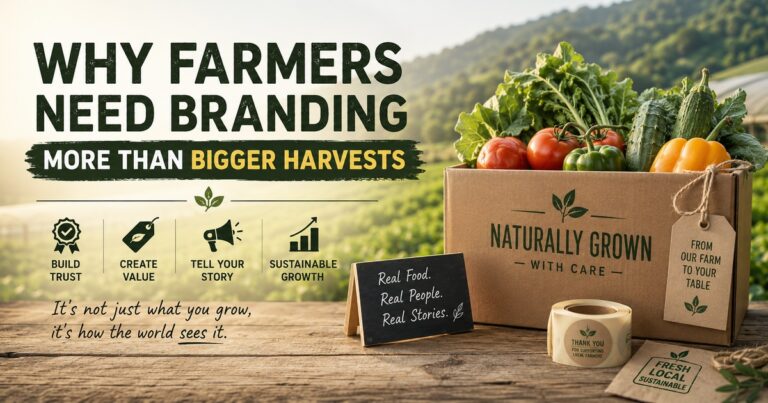
This is why I see value addition and branding as closely connected.
A farmer can produce an excellent product, but if the customer cannot understand why it is special, the additional value may never be realised.
This connects directly with something I wrote about earlier:
Farmers need to think about branding, not just production.
The product sitting in a crate may be a commodity.
The same product inside a trusted brand can become something different.
Himalayan Agriculture Has an Interesting Opportunity
I particularly see an opportunity for Himalayan agriculture in this area.
Himachal Pradesh has a wide range of fruits, vegetables and traditional food products.
The region itself can become part of the product story.
But simply writing “Himalayan” on a label doesn’t create value.
The claim needs substance.
The product needs quality.
The supply needs consistency.
The story needs to be genuine.
And the business needs to build trust.
For me, this is where farming, technology and branding start coming together.
Technology can help with traceability.
Good packaging can protect the product.
Digital marketing can tell the story.
E-commerce can reach customers outside the immediate region.
Data can show which products customers actually buy.
And processing can extend the market beyond the short harvest window.
This is much more interesting to me than thinking of farming purely as growing crops.
Farmer Producer Companies Can Play an Important Role
Not every farmer has enough production to justify their own processing unit.
This is where collective models can become important.
A Farmer Producer Company or farmer group can potentially aggregate:
- Raw material
- Capital
- Equipment
- Processing facilities
- Knowledge
- Packaging
- Marketing
- Distribution
Imagine 100 farmers each producing a relatively small quantity of a crop.
Individually, building a processing business may not make economic sense.
Collectively, the same production may become enough to support a small processing and branding operation.
This is one reason I believe farmer organisations should think beyond collective selling.
The next step can be collective value creation.
Instead of only asking:
“How can we sell our produce together?”
the better question may sometimes be:
“What can we make together that customers will pay more for?”
Value Addition Does Not Have to Mean a Factory
This is important, especially for small farmers.
Value addition can happen at different levels.
Level 1: Better handling
Cleaning, sorting, grading and reducing damage.
Level 2: Better packaging
Creating appropriate packs for different customers.
Level 3: Branding
Giving the product a recognisable identity.
Level 4: Simple processing
Drying, milling, pickling, preserving or similar activities where appropriate.
Level 5: Product development
Creating a finished consumer product.
Level 6: Building a brand
Developing repeat customers and distribution.
A farmer doesn’t have to jump directly from Level 1 to Level 6.
In fact, I think that would often be a mistake.
Start with the smallest meaningful improvement.
Learn.
Then move up.
The Economics Matter More Than the Selling Price
One thing I would strongly caution against is looking at the retail price and assuming the farmer can capture the difference.
Suppose fresh tomatoes sell for ₹30/kg and tomato sauce sells at a much higher equivalent price.
It would be wrong to conclude:
“We should process tomatoes because the sauce sells for much more.”
There are many costs between the tomato and the final product.
Processing causes yield loss.
There are ingredients.
Labour.
Electricity.
Equipment depreciation.
Packaging.
Labelling.
Testing.
Storage.
Transportation.
Marketing.
Retail margins.
Taxes and compliance costs where applicable.
Returns and wastage.
Working capital.
So the right question isn’t:
“How much more does the processed product sell for?”
The right question is:
“How much additional profit remains after all the additional costs and risks?”
That is a much more useful way to think.
Small Experiments Can Be Better Than Big Investments
This is probably the approach I would personally prefer.
Instead of immediately building a large processing facility, start with a small product experiment.
For example:
Take a crop that you already grow.
Identify one possible value-added product.
Make a small quantity through a compliant processing setup.
Create simple packaging.
Offer it to a limited number of customers.
Ask for honest feedback.
Measure:
- Cost per unit
- Selling price
- Gross margin
- Repeat purchases
- Customer complaints
- Shelf life
- Packaging performance
- Delivery cost
- Actual demand
Then decide whether it deserves investment.
This approach reduces the risk of building something based purely on assumptions.
The Internet Makes Small-Batch Value Addition More Interesting
This is where my technology side becomes relevant.
A small farmer no longer necessarily has to depend entirely on local customers.
Digital channels can make it possible to test products with customers outside the immediate farming area.
A farmer can:
- Build a simple website
- Sell through social media
- Collect customer feedback
- Create an email list
- Use WhatsApp for repeat orders
- Test different packaging
- Track which products sell
- Build a customer database
- Tell the farm’s story online
This doesn’t mean technology solves every agricultural problem.
It doesn’t.
But it gives a small agricultural business tools that were previously available mainly to larger companies.
That is a major change.
Export Is the Bigger Long-Term Opportunity
Once you start thinking about value-added agricultural products, export markets become interesting too.
India already exports a wide range of processed agricultural products.
APEDA’s data shows that processed vegetables, processed fruits and juices, pulses, cereal preparations and other processed categories contribute significant export value.
The opportunity is not simply to export more raw agricultural commodities.
It is to build products that can compete on:
- Quality
- Consistency
- Safety
- Packaging
- Traceability
- Shelf life
- Convenience
- Brand
- Origin
But exports also make the requirements more demanding.
A product intended for international markets may need to meet specific quality, labelling, sanitary and phytosanitary requirements.
So I don’t see export as an easy shortcut.
I see it as the next level of agricultural business maturity.
Technology and Value Addition Will Increasingly Meet
This is an area I am particularly interested in.
The future of agricultural value addition is not just about traditional processing.
It can also involve technology.
For example:
Sensors → better storage conditions
IoT → monitoring cold chains
AI → demand forecasting
Digital marketplaces → connecting producers with buyers
Traceability systems → showing where products came from
Data analysis → identifying profitable products
E-commerce → reaching consumers directly
APEDA’s recent initiatives also highlight areas such as digital marketplaces, traceability, IoT monitoring, post-harvest technology, shelf-life enhancement and supply-chain optimisation as important parts of an export-oriented agri-food ecosystem.
This is exactly where I think my two interests- agriculture and technology- can intersect.
Farmers Need to Start Thinking Like Product Developers
This may sound unusual, but I think the farmer of the future will need to think partly like a product developer.
A product developer asks:
Who is the customer?
What does the customer want?
What problem are we solving?
What should the product look like?
What should it cost?
How should it be packaged?
How can we make people buy it again?
These are not traditionally farming questions.
But increasingly, they are agricultural business questions.
The farmer who learns to ask them may have an advantage over someone who only focuses on production.
The Biggest Opportunity May Be Sitting in the Farm’s “Waste”
There is another idea I find particularly exciting.
What we call waste may sometimes be an underutilised resource.
Fruit that doesn’t meet premium fresh-market appearance standards.
Peels.
Seeds.
Leaves.
By-products from processing.
Surplus production.
Depending on the crop and food-safety considerations, these materials may have potential uses in other products, animal feed, composting, extraction or other industries.
The point isn’t that everything can be monetised.
It can’t.
The point is to start asking:
“Is this actually waste, or have I simply not found its next use?”
That mindset can lead to interesting businesses.
But Value Addition Is Not for Everyone
I don’t want to make value addition sound like a guaranteed solution.
It isn’t.
Processing adds complexity.
A farmer who produces crops has one business.
A farmer who processes those crops now has another business layered on top.
There are additional responsibilities.
Food safety.
Quality control.
Packaging.
Inventory.
Shelf life.
Compliance.
Customer service.
Marketing.
Working capital.
Distribution.
Returns.
A farmer should not enter processing simply because someone says margins are higher.
The business needs to make sense.
Sometimes the smartest decision may be to sell the crop fresh.
Sometimes the better option may be to partner with an existing processor.
Sometimes farmers can create a joint processing facility.
Sometimes a farmer may build a small premium brand.
There is no single model.
The Future May Belong to Farmers Who Capture More of the Value Chain
I don’t think farmers need to control the entire agricultural value chain.
That would be unrealistic.
But I do think there is an opportunity to move one or two steps closer to the customer.
Instead of:
Farmer → trader → wholesaler → retailer → consumer
there could be models such as:
Farmer → processor → brand → consumer
or:
Farmer group → processing unit → brand → retailer
or:
Farmer → direct customer
or even:
Farmer → farmer-owned brand → multiple markets
The important thing is not which model wins.
The important thing is that farmers have choices.
More choices mean less dependence on a single channel.
What I Would Look for Before Starting a Value-Added Product
If I were evaluating a new value-added agricultural product, I would probably start with these questions:
1. Do I already have access to the raw material?
If not, supply becomes another problem.
2. Is there a real customer?
Not “people might like it.”
Actual customers.
3. Does processing solve a problem?
Longer shelf life? Convenience? Better transport? Better taste? Seasonal availability?
4. Can I produce consistent quality?
One excellent batch is not enough.
5. What is the complete cost?
Not just raw material and packaging.
Everything.
6. Can I test it on a small scale?
If yes, do that first.
7. Can I build a brand around it?
A commodity business and a branded business behave very differently.
8. Can I sell it beyond my local market?
Online, through retailers, institutions, or eventually through exports.
9. What regulations apply?
This needs to be understood before commercial production.
10. Will customers buy it again?
This may be the most important question of all.
A first purchase can come from curiosity.
A second purchase usually comes from satisfaction.
I Don’t Want to Just Grow More. I Want to Create More Value.
This is probably the biggest change in my thinking.
As a farmer, it is natural to focus on the crop.
How many plants?
How much production?
What is the yield?
What is today’s market price?
But I increasingly think there is another set of questions that matters just as much.
Who is buying it?
Why are they buying it?
What happens after harvest?
Can I make the product more useful?
Can I extend its shelf life?
Can I build a brand around it?
Can technology help me reach a better market?
Can I capture a little more of the value created between the farm and the consumer?
That is the direction in which I think modern farming needs to move.
Not away from production.
Beyond production.
Agriculture Is More Than Growing Food
I still enjoy the basic part of farming- the soil, the plants, the changing seasons and the satisfaction of seeing something grow.
But I no longer think of farming as only an agricultural activity.
It is also a business.
And a modern agricultural business can involve:
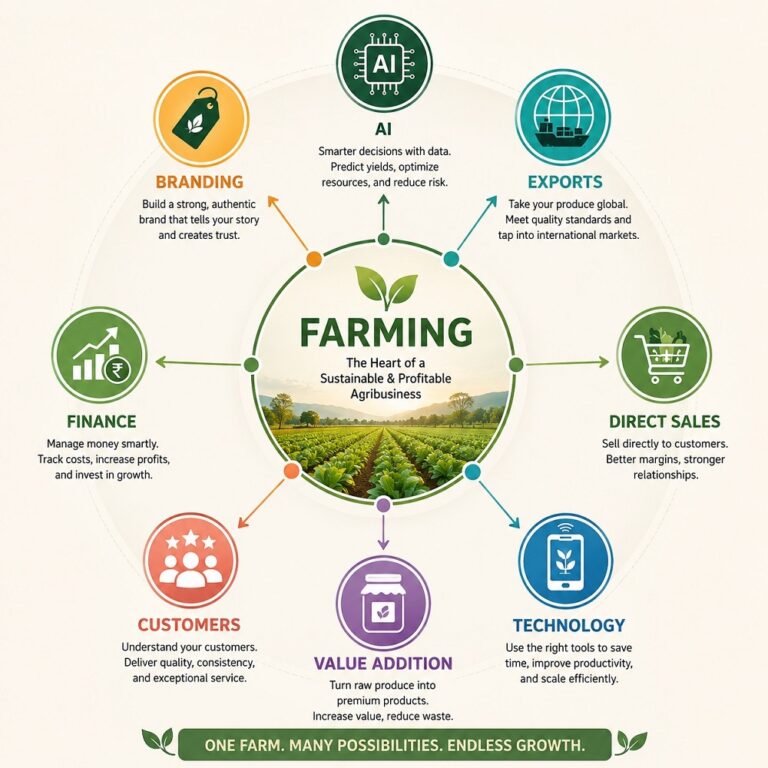
Production + Processing + Branding + Technology + Marketing + Logistics + Customer Relationships
The farmer who controls only production may capture only a small part of the final value.
The farmer or farmer group that learns to participate in more of these stages has the possibility of building something much bigger.
That doesn’t mean every farmer needs a factory.
It means every farmer should at least understand where the value is being created.
My Takeaway
I don’t believe the answer to low farm income is always “grow more.”
Sometimes the better question is:
“Can I create more value from what I already grow?”
A kilogram of produce will always have a commodity price.
But a well-designed product can have a customer value.
That difference is where the opportunity lies.
For a farmer growing kiwi, it could mean thinking beyond selling fresh kiwi.
For someone growing tomatoes, it could mean exploring sauces, purees or other products.
For an apricot grower, drying may open a completely different market.
For a dairy farmer, processing can create products with a longer shelf life and different customers.
For a farmer group, collective processing and branding could create an entirely new business.
And for someone like me, who is interested in both farming and technology, this is where things become especially interesting.
I don’t want to look at agriculture only from the perspective of how much I can grow. I want to understand how much value I can create.
Because perhaps the next big opportunity for Indian farmers isn’t simply producing more food.
It is learning how to turn what they already produce into better products, stronger brands and better businesses.