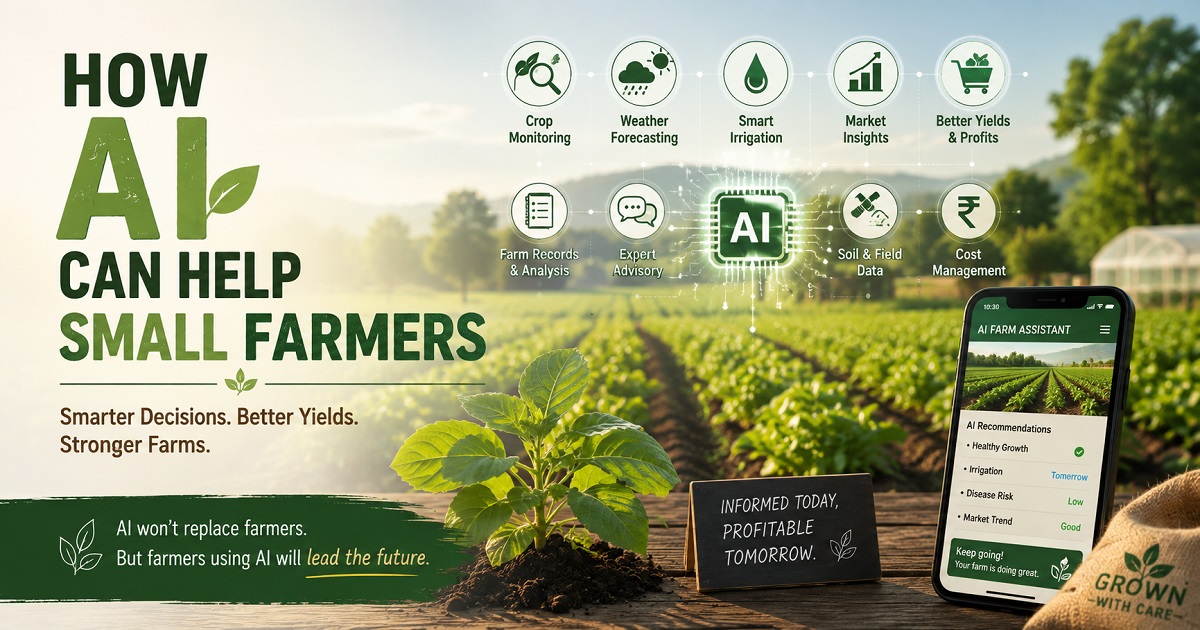
How AI Can Help Small Farmers: Practical Uses & Benefits
For a long time, I thought of technology and farming as two very different worlds.
One was about soil, weather, crops, pruning, irrigation and harvesting. The other was about computers, websites, software and the internet.
But the more time I spend around both, the more I realise that they are becoming difficult to separate.
A farmer today is not only making decisions about what to grow. He is also making decisions about when to plant, when to irrigate, which input to use, where to sell, what price to accept, how to reach customers and how to reduce risk.
And almost every one of those decisions involves information.
That is where I think artificial intelligence can become genuinely useful for small farmers.
I don’t believe AI will magically solve the problems of farming. It won’t replace experience, and it certainly won’t make agriculture risk-free.
But I do believe it can help a farmer make better decisions with the information available to him.
That distinction is important.
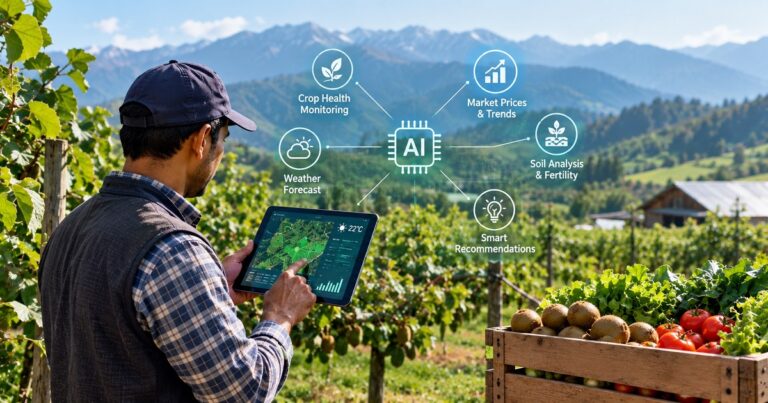
The future of AI in agriculture, in my opinion, isn’t necessarily a robot driving around every small farm. It may be something much simpler: a farmer with a smartphone who can ask a question, upload a picture of a crop, understand weather risks, compare market information and maintain better farm records.
That could be much more powerful than it sounds.
Small Farmers Don’t Have a Lack of Knowledge. They Have a Lack of Timely Information.
One of the biggest misconceptions about technology in agriculture is that farmers don’t know enough.
I don’t agree with that.
Farmers have an enormous amount of practical knowledge.
They know their soil. They know how their crops behave. They notice changes in weather. They understand local conditions. Many can identify problems in a crop simply by looking at the leaves.
The problem is that agriculture involves too many variables.
A farmer may know his field extremely well, but he cannot personally monitor every weather pattern, market movement, pest outbreak, government notification, scientific publication and crop disease development.
This is where AI can act as an information assistant.
It can take large amounts of information and make it easier to understand.
The World Bank’s recent work on AI in agriculture makes a similar point: AI can potentially help smallholder farmers with production, climate resilience, farm decisions and value chains, but its usefulness depends on appropriate data, infrastructure, skills and responsible implementation.
That is an important distinction.
AI should not replace the farmer’s knowledge.
It should amplify it.
AI Doesn’t Have to Mean Expensive Robots
When people hear “AI in agriculture”, they often imagine autonomous tractors, agricultural robots, drones flying over thousands of acres or highly automated greenhouses.
Those technologies are exciting.
But they aren’t necessarily the most relevant starting point for a small farmer.
A farmer with five acres doesn’t need the same technology as a corporation managing 50,000 acres.
For a small farmer, the most valuable AI applications may be much simpler:
- Asking questions through a mobile phone
- Identifying possible crop diseases from photographs
- Understanding weather forecasts
- Receiving location-specific farming advice
- Comparing market information
- Keeping farm records
- Analysing expenses
- Planning irrigation
- Understanding customer demand
- Writing product descriptions and marketing material
- Finding potential buyers
- Translating agricultural information into local languages
Some of these things are already happening.
FAO describes digital agriculture and AI as tools that can support precision farming, climate-smart agriculture, supply-chain optimisation and market access.
And in India, AI-enabled agricultural advisory is no longer just a theoretical discussion. ICAR has been working on AI-enabled advisory systems, while government initiatives such as Bharat-VISTAAR are designed to provide multilingual agricultural information and advisories through digital channels.
The important thing is that AI is becoming more accessible through the device farmers already carry in their pockets: the smartphone.
1. AI Can Help Farmers Identify Crop Problems Earlier
Imagine walking through your field and noticing something unusual on a leaf.
Maybe there are spots.
Maybe the edges are turning yellow.
Maybe insects are present.
Maybe the plant is showing signs of stress.
Traditionally, a farmer might ask another farmer, contact a local input dealer or wait until an agricultural expert becomes available.
Sometimes that works.
Sometimes the problem has already spread by then.
AI-based image recognition can potentially provide an early indication of what might be happening.
A farmer could photograph the affected plant and use an AI-powered system to identify possible diseases, pests or nutritional problems.
India is already moving in this direction. The National Pest Surveillance System, for example, uses AI and machine learning to help identify pest infestations and crop diseases from images uploaded by farmers.
There is an important caveat here.
I would never recommend that a farmer blindly follow an AI diagnosis and immediately spray a chemical.
AI should be treated as an assistant, not as the final authority.
A better process would be:
Photo → AI suggestion → verification → appropriate action.
That verification could come from an agricultural expert, KVK, agronomist or other trusted source.
This is particularly important because a wrong diagnosis can cost a farmer money.
2. AI Can Make Weather Information More Useful
Farmers have always watched the weather.
But traditional weather knowledge is becoming more difficult to rely on as weather patterns become increasingly unpredictable.
Rain at the wrong time can damage a crop.
Unexpected hail can destroy fruit.
A heat wave can affect flowering.
Heavy rainfall can increase disease pressure.
A sudden cold spell can damage sensitive crops.
The problem isn’t simply getting a weather forecast.
The real question is:
“What does this forecast mean for my farm?”
That is where AI can potentially become useful.
Instead of simply saying:
Rain expected tomorrow.
A useful agricultural system could eventually say something closer to:
Heavy rain is expected in your area over the next 24 hours. Consider delaying irrigation and checking drainage around your crop.
Or:
High humidity and rainfall conditions may increase the risk of fungal disease in your crop. Monitor affected areas closely.
The difference is huge.
The first gives you information.
The second helps you make a decision.
FAO highlights AI’s potential in areas such as climate resilience, agricultural forecasting and resource efficiency.
For small farmers, turning complicated information into a practical decision may be one of AI’s greatest benefits.
3. AI Can Help With Irrigation
Water is one of the most important resources on a farm.
Yet irrigation decisions are often based on habit.
“I irrigate every three days.”
“Everyone in the village is irrigating today.”
“The soil looks dry.”
These aren’t necessarily bad approaches. Farmers develop routines based on experience.
But imagine combining:
- Soil moisture
- Weather forecasts
- Temperature
- Humidity
- Crop type
- Crop growth stage
- Rainfall history
- Evapotranspiration data
An AI system could potentially analyse these variables and recommend when irrigation is actually needed.
With sensors, the system becomes even more useful.
A relatively simple setup could collect soil moisture data and send it to software that combines it with weather information.
The goal isn’t to make farming complicated.
The goal is to avoid unnecessary decisions based on guesswork when better information is available.
For a small farmer, saving water can also mean saving money.
4. AI Can Help Farmers Understand Their Costs
This is an area that I think doesn’t receive enough attention.
Farmers often know how much they sold their crop for.
But do they always know exactly how much it cost to produce?
Seed.
Plants.
Fertiliser.
Organic inputs.
Labour.
Irrigation.
Electricity.
Fuel.
Machinery.
Packaging.
Transportation.
Market commissions.
Storage.
Spoilage.
These costs add up.
A farmer might sell a crop for what looks like a good price and still discover that the actual profit was surprisingly small.
This is where AI combined with simple farm-management software can become useful.
A farmer could maintain basic records throughout the season and ask:
Which crop made me the most profit?
Where did most of my money go?
Which field had the highest production cost?
How much did transportation reduce my margin?
What was my cost per kilogram?
How did this season compare with last season?
These are business questions.
And increasingly, farming needs to be treated as a business.
AI can help analyse the data, but the farmer still needs to collect the data in the first place.
That is why I think digital record keeping may actually be more important than sophisticated AI for many small farms.
AI is only as useful as the information it has to work with.
5. AI Can Help With Crop Planning
Choosing what to grow is one of the most important decisions a farmer makes.
And yet many farmers make this decision based heavily on tradition.
“My neighbour is growing tomatoes.”
“Tomato prices were good last year.”
“This crop has always been grown here.”
Sometimes that works.
But agriculture is cyclical.
Prices change.
Demand changes.
Weather changes.
Production changes.
A crop that was highly profitable last year can become unprofitable when thousands of farmers plant the same thing the following year.
AI could potentially combine historical prices, weather conditions, crop calendars, local production information and market demand to help farmers compare different options.
It shouldn’t say:
“Grow this crop. You will make ₹X lakh.”
Agriculture isn’t predictable enough for that kind of certainty.
Instead, a useful system might say:
“Based on historical conditions and available market information, these three crops appear to have different levels of opportunity and risk.”
That is much more realistic.
AI should support decisions, not pretend to predict the future perfectly.
6. AI Can Help Small Farmers Access Agricultural Knowledge
This may be one of the biggest opportunities.
Agricultural knowledge exists everywhere.
ICAR research.
Agricultural universities.
Government departments.
Extension workers.
Research papers.
Farmer experiences.
Technical manuals.
Weather information.
Crop advisories.
But the information is often scattered.
And sometimes it is written in a language or technical style that isn’t easy for a farmer to understand.
AI can act as a bridge.
A farmer could ask:
“My kiwi plants are showing this symptom. What could be the reason?”
Or:
“Explain this agricultural recommendation in simple Hindi.”
Or:
“What should I check before planting tomatoes?”
Or:
“What questions should I ask before buying this agricultural input?”
Voice-based AI could make this even more accessible.
This is particularly important in India, where language and literacy can be barriers to accessing technical information.
India’s recent agricultural AI initiatives are already moving toward multilingual and voice-enabled services.
That is the direction I find particularly interesting.
The farmer shouldn’t have to learn how to use complicated software. The software should learn how to communicate with the farmer.
7. AI Can Help Farmers Sell Better
Growing a good crop is only half the business.
I’ve become increasingly convinced of this through my own experience with agriculture.
A farmer can spend months growing a crop and then discover that selling it is the hardest part.
Who is the buyer?
What quantity do they need?
What quality?
What price?
Where do they want delivery?
How should the product be packaged?
How can the farmer reach customers directly?
This is where AI can potentially help small farmers move beyond simply producing commodities.
Imagine a farmer maintaining a digital catalogue of his produce.
AI could help create:
- Product descriptions
- Customer messages
- Price comparisons
- WhatsApp responses
- Social media content
- Multilingual marketing material
- Buyer profiles
- Order summaries
- Invoices
- Product catalogues
That may sound like marketing rather than agriculture.
But marketing is now part of agriculture.
A farmer who can grow something and communicate its value has an advantage over a farmer who can only produce it.
This is one reason I believe the future farmer will need to understand both production and marketing.
8. AI Can Help Small Farmers Build a Brand
This connects directly with something I’ve been thinking about more seriously: farmers need branding.
There are thousands of farmers producing tomatoes.
Thousands producing vegetables.
Thousands producing fruit.
So why would a customer choose one farmer over another?
Price is one answer.
But it doesn’t have to be the only answer.
A farmer can build trust around:
- Where the produce comes from
- How it is grown
- Who grows it
- What farming practices are followed
- How it is harvested
- How it reaches the customer
- What makes the farm different
AI can help a farmer communicate this story.
A farmer doesn’t need to become a professional copywriter.
He can describe his farm in his own words and use AI to help turn that information into a website page, product description, social media post or customer message.
But I think the story must come from the farmer.
AI can improve the communication.
It shouldn’t manufacture the identity.
That’s an important difference.
9. AI Can Help With Farm Records and Documentation
Paperwork is another hidden cost of running a farm business.
Invoices.
Purchase records.
Sales.
Customer lists.
Input expenses.
Labour records.
Harvest quantities.
Inventory.
Certificates.
Transport details.
Payments.
For an individual farmer, this can become difficult to maintain.
AI-powered software could make record keeping conversational.
Instead of filling out complicated forms, a farmer could potentially say:
“Today I harvested 85 kilograms of tomatoes.”
And the system could update the farm record.
Or:
“Sold 40 boxes of kiwi to this buyer at this price.”
Over time, that information becomes valuable.
The farmer starts building a digital history of the farm.
And that history can eventually help with planning, financing, insurance, traceability and business decisions.
10. AI Could Help Farmers Make Better Market Decisions
Agricultural markets are complicated.
Prices can vary significantly between locations and channels.
A farmer might receive one price at the farm gate and another price somewhere else.
But transportation, handling and time also have costs.
So the highest market price isn’t necessarily the most profitable option.
This is an area where data and AI could become particularly interesting.
Imagine a system that helps a farmer compare:
Local buyer
vs.
Wholesale market
vs.
Retailer
vs.
Direct consumer
vs.
Institutional buyer
The system could consider expected price, transportation, quantity, quality requirements, payment terms and other costs.
The result would not simply be:
“Sell here.”
It could instead show:
“This option offers a higher gross price, but transportation and handling reduce the expected margin.”
That is much closer to the kind of decision support I think farmers actually need.
FAO has also highlighted the potential for digital technologies to improve market access and help smallholders integrate more effectively into markets and value chains.
But There Is a Problem: AI Can Also Give Bad Advice
This is where I think we need to be careful.
AI is powerful.
But it is not automatically correct.
A chatbot can sound extremely confident while giving an incorrect answer.
That is particularly dangerous in agriculture.
Imagine an AI incorrectly identifies a disease.
The farmer follows its recommendation.
The crop gets worse.
Or imagine an AI predicts that a particular crop will have a high price.
The farmer invests heavily.
Prices collapse.
Who takes responsibility?
This is one reason I don’t believe farmers should treat AI predictions as guarantees.
AI should reduce uncertainty, not pretend to eliminate it.
For important decisions, farmers should still verify information through agricultural experts, local conditions, reliable data and their own experience.
The World Bank also stresses that AI isn’t a silver bullet and that its usefulness depends on reliable data, connectivity, local adaptation and institutions that farmers trust.
That is exactly how I think we should approach it.
AI Cannot Understand a Farm Without Data
There is another fundamental issue.
AI needs data.
If I tell an AI:
“I have a problem with my crop.”
That isn’t enough.
What crop?
Which variety?
Where is the farm?
What altitude?
What soil?
What weather?
What irrigation?
What was planted when?
What inputs were used?
What symptoms appeared first?
How widespread is the problem?
The more useful information we provide, the better the potential advice becomes.
This means that the future of AI agriculture will depend heavily on good farm data.
That could include:
- Farm location
- Crop history
- Soil information
- Weather
- Irrigation
- Input usage
- Pest and disease observations
- Harvest quantities
- Prices
- Sales
- Labour
- Expenses
For me, this is one of the most interesting parts of agricultural technology.
The real transformation may not come from AI alone.
It may come from the combination of:
Farm data + connectivity + AI + farmer experience.
Small Farmers Don’t Need to Adopt Everything
I would also caution farmers against the temptation to buy technology simply because it is called “smart”.
A sensor isn’t automatically useful because it has AI.
A drone isn’t automatically profitable because it is advanced.
An app isn’t useful simply because it has hundreds of features.
The first question should always be:
What problem am I trying to solve?
If irrigation is wasting water, look at irrigation technology.
If disease detection is a problem, explore image-based diagnostics.
If records are poor, start digital record keeping.
If marketing is the problem, build a digital customer channel.
If market information is difficult to access, look for better data.
Technology should follow the problem.
Not the other way around.
The Smartphone May Become the Most Important Farm Tool
When I think about AI and small farmers, I keep coming back to one simple device.
The smartphone.
It already provides a camera.
Internet access.
Voice input.
Messaging.
GPS.
Applications.
Payments.
And now increasingly, access to AI.
That changes the economics of agricultural technology.
A small farmer doesn’t necessarily need to purchase a sophisticated computer system.
A large part of the digital agricultural ecosystem can potentially reach him through a device he already owns.
This is one reason I think AI has the potential to be more inclusive than some previous waves of agricultural technology.
But access alone isn’t enough.
The tools must be affordable, easy to use, available in local languages and designed around real farming problems.
FAO’s research on agricultural digitalisation has repeatedly highlighted barriers such as investment costs, digital skills and the need for an enabling environment for small-scale producers.
What I Would Like to See in an AI Tool for Small Farmers
If I were designing an AI platform specifically for small farmers, I wouldn’t start with hundreds of features.
I’d start with a simple question:
What decisions does a farmer struggle with every week?
Then I would build around those decisions.
For example:
“What should I do today?”
The system could combine weather, crop stage, recent observations and farm records.
“Does my crop look healthy?”
The farmer uploads a photograph.
“Is this pest serious?”
The system provides possible identification and suggests what should be verified.
“Should I irrigate?”
The system looks at soil moisture, crop requirements and weather.
“Where should I sell?”
The system compares available market channels.
“Am I making money?”
The system analyses costs and sales.
“What should I plant next season?”
The system helps compare options rather than giving an unrealistic guarantee.
“How do I reach customers?”
The system helps with product presentation, communication and marketing.
That would be much more useful to me than an AI system simply telling farmers that AI is the future.
What AI Will Not Replace
There is a lot of discussion about AI replacing people.
In agriculture, I don’t think that’s the right way to look at it.
AI cannot replace the farmer’s relationship with his land.
It cannot physically inspect every part of a field with human judgement.
It cannot understand every local condition.
It cannot replace years of accumulated practical experience.
It cannot negotiate every relationship with buyers.
And it certainly cannot take responsibility for the farm.
Instead, I see AI becoming another tool in the farmer’s toolbox.
Just as tractors didn’t eliminate farmers.
Irrigation systems didn’t eliminate farmers.
Mobile phones didn’t eliminate farmers.
AI doesn’t need to eliminate farmers either.
It can make a farmer better informed.
And sometimes, that is enough to make a meaningful difference.
My Own Interest in AI and Agriculture
This is where my personal interest in technology comes into the picture.
I don’t see technology as something separate from farming.
I enjoy working with websites, digital businesses and technology, while at the same time being involved in farming and growing crops.
That combination has changed how I look at agriculture.
When I look at a farming problem, I don’t only ask:
“How can I grow this better?”
I increasingly ask:
“How can I make the entire system better?”
How can I record it?
How can I market it?
How can I reach customers?
How can I understand the numbers?
How can I reduce waste?
How can I use technology without losing the human side of farming?
These questions are the reason AI in agriculture interests me.
I don’t want technology for the sake of technology.
I want technology that solves an actual problem.
The Farmer of the Future May Be More Like an Entrepreneur
I think this is one of the biggest changes coming to agriculture.
The farmer of the future won’t necessarily be defined only by how many acres he owns.
He may be defined by how effectively he combines:
land + knowledge + technology + data + markets + customers.
A farmer with a relatively small holding could potentially build a valuable business if he produces something differentiated, understands his costs, builds a brand and reaches the right customers.
That is very different from the traditional idea that farming becomes profitable only by increasing acreage.
Technology can help make small operations more intelligent.
AI can potentially make that intelligence more accessible.
But We Should Not Forget the Human Side
There is a danger that we become so excited about AI that we forget what agriculture actually is.
Agriculture is still biological.
Plants don’t follow software instructions perfectly.
Weather doesn’t follow algorithms.
Markets don’t behave predictably.
And farming is still deeply connected to people.
The farmer.
The farm worker.
The buyer.
The customer.
The local community.
The soil.
The environment.
Technology should strengthen those relationships rather than replace them.
For me, that is especially important when talking about natural and sustainable farming.
I don’t want to use technology to turn farming into something disconnected from nature.
I want to use technology to understand farming better while remaining connected to the land.
The Real Opportunity Is Not “AI for Farmers”
I think the bigger opportunity is:
AI that actually understands farmers.
There is a difference.
A generic AI tool can answer questions about agriculture.
A truly useful agricultural AI system would understand:
- Local crops
- Local weather
- Local languages
- Local markets
- Local farming practices
- Local risks
- Farm history
- Farmer preferences
- Available resources
It would understand that a farmer in Himachal Pradesh faces very different conditions from a farmer in Punjab, Maharashtra or Karnataka.
It would understand that a small orchard farmer has different needs from a large commercial grain operation.
And it would understand that advice needs to be practical.
Not academic.
Not complicated.
Not filled with technical terminology.
Useful.
That is where I think the real opportunity lies.
AI Should Make Farming More Intelligent, Not More Complicated
There is a temptation in technology to make everything more sophisticated.
But sophistication isn’t the goal.
A farmer doesn’t care whether the technology uses a complicated machine-learning model.
He cares whether it helps him answer a question.
Should I irrigate?
Is this disease?
When should I harvest?
What is my cost?
Where should I sell?
How can I reach customers?
What should I grow?
How can I reduce risk?
If AI can help answer those questions accurately and affordably, then it has real value.
If it cannot, then calling something “AI-powered” doesn’t make it useful.
The Next Agricultural Revolution May Be About Decisions
We’ve already seen agricultural revolutions driven by improved seeds, irrigation, mechanisation, fertilisers and infrastructure.
I believe the next major transformation could be driven by something less visible:
better decisions.
A farmer who makes slightly better decisions every week can potentially create a significant difference over an entire season.
Better irrigation decisions.
Better crop planning.
Better pest monitoring.
Better purchasing.
Better harvesting.
Better pricing.
Better marketing.
Better record keeping.
Better customer relationships.
AI won’t necessarily create one dramatic change.
It may create hundreds of small improvements.
And those small improvements could eventually add up.
My View: AI Should Empower the Small Farmer
I don’t believe the future of agriculture belongs only to large farms with massive technology budgets.
If anything, I think AI has the potential to give small farmers access to capabilities that were previously available mainly to larger businesses.
A large agricultural company can hire agronomists, analysts, marketing teams, data scientists and managers.
A small farmer cannot.
But AI could potentially give one farmer access to some of those capabilities at a much lower cost.
Not perfectly.
Not completely.
But enough to make a difference.
That is what excites me.
Because if AI is developed responsibly, it could make knowledge more accessible rather than concentrating it in the hands of those who can afford it.
The Future Farmer Will Still Need to Think
Perhaps the most important point I would leave farmers with is this:
Don’t stop thinking just because AI is available.
Use it.
Question it.
Verify it.
Learn from it.
Compare its suggestions with your own experience.
And most importantly, understand the reasoning behind important decisions.
A farmer who blindly follows AI isn’t necessarily a modern farmer.
A farmer who knows how to combine experience + data + technology + judgement is.
That, to me, is the real promise of AI in agriculture.
I Don’t Think AI Will Replace Farmers
I think it will change what farmers do.
The farmer who once spent hours searching for information may increasingly use AI to find it.
The farmer who relied entirely on memory may start using digital records.
The farmer who sold only through traditional channels may reach customers directly.
The farmer who looked at a crop problem only with his eyes may also use image analysis.
The farmer who made decisions mainly from experience may combine experience with data.
And the farmer who learns how to use these tools effectively may have an advantage over one who refuses to adapt.
I don’t see AI as the end of farming.
I see it as another stage in farming’s evolution.
My takeaway
I’m still a farmer.
I still believe that farming starts with the soil, the crop, the weather and the person willing to work with all of them.
But I also believe that farming cannot remain disconnected from technology.
For me, the interesting future is not technology versus traditional farming.
It is the combination of both.
Natural farming + technology.
Farmer experience + data.
Human judgement + artificial intelligence.
That combination could give small farmers something they have always needed but often lacked:
better information at the right time to make better decisions.
And if we can make that technology affordable, simple and accessible, AI may not just become a tool for large agricultural companies.
It could become one of the most useful tools available to the small farmer.