What Does Healthy Soil Actually Look Like to a Farmer?
A field can look green from a distance and still have problems beneath the surface.
The crop may be growing, the leaves may look healthy, and the plants may even be producing a reasonable harvest. But dig a little deeper, and you might find compacted soil, weak roots, poor water movement or very little decomposed organic matter.
This is why experienced farmers do not judge soil health by looking at the crop alone. They pay attention to the ground beneath it.
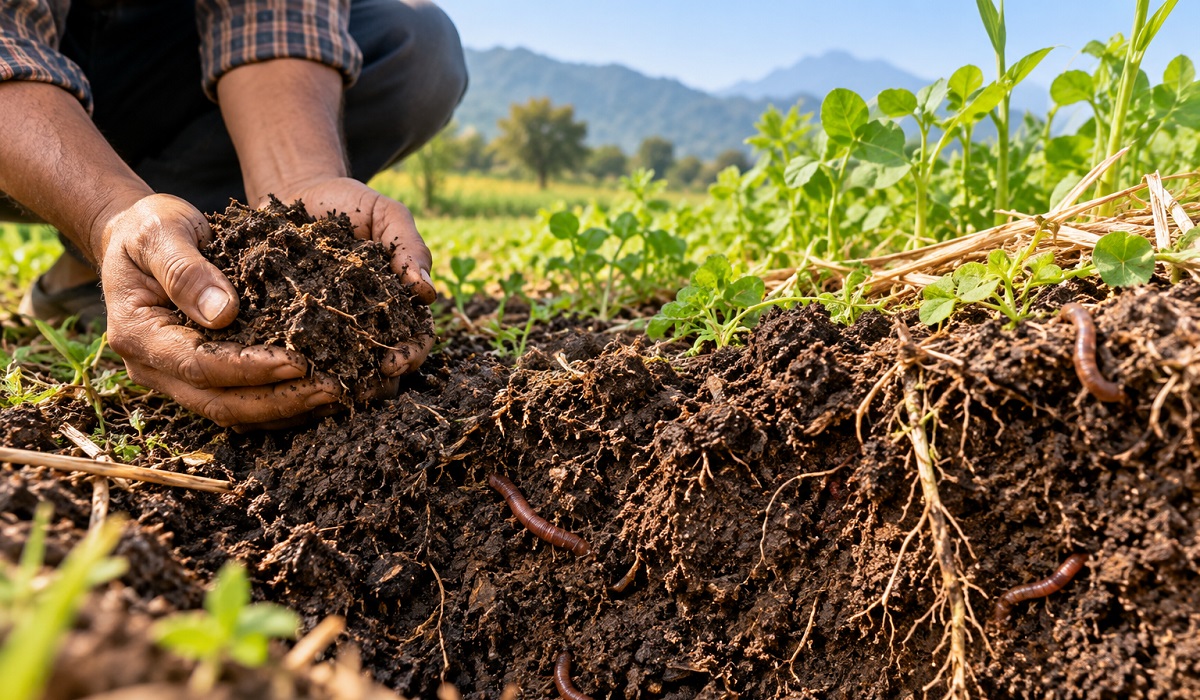
Healthy soil has a way of revealing itself. You can observe it when you dig a small hole, examine a handful of earth, watch how water enters the ground or pull out a plant and inspect its roots.
For farmers practising natural farming, organic farming, regenerative agriculture or conventional farming, these observations can provide useful clues about what is happening in the field.
But what exactly should we look for?
1. Healthy Soil Has a Good Structure
One of the first things a farmer can examine is the structure of the soil.
Take a small amount of soil from the root zone when it is slightly moist. Does it break into small crumbs or aggregates? Can you see small spaces between them? Or does it form a hard mass that is difficult to break apart?
Soil with a good structure often contains aggregates held together by organic matter, roots, fungal threads and other biological processes.
These aggregates create spaces through which air and water can move.
Good soil structure helps roots explore the soil, allows rainfall to infiltrate and gives soil organisms a suitable environment to live in.
In contrast, severely compacted soil may become hard, restrict root growth and allow water to run off instead of entering the ground.
However, not every healthy soil will look the same. Sandy soil, clay soil, alluvial soil and mountain soil naturally have different structures. The goal is not to make every field look identical. It is to improve the structure in a way that suits the soil type and crop.
What a farmer can do: Examine the soil at different depths, particularly in the active root zone. Compare areas where crops grow well with areas where growth is weak.
2. The Soil Smells Like Earth, Not Rot
Smell is one of the simplest observations a farmer can make.
Take a handful of moist soil and smell it. Healthy, biologically active soil often has a fresh, earthy smell. This comes partly from compounds produced by soil microorganisms.
The smell can be particularly noticeable after rainfall or when soil is disturbed.
But smell should not be treated as a scientific test by itself.
Soil that smells strongly sour, putrid or like rotten eggs may be waterlogged or poorly aerated. Such conditions can encourage oxygen-depleted processes that are harmful to many crop roots.
Freshly added manure, undecomposed residues and certain amendments can also change the smell temporarily.
A pleasant smell is encouraging, but it does not prove that the soil has the right nutrient balance or is free from contaminants.
What a farmer can do: Smell soil from different parts of the field. If an area consistently smells unpleasant and remains wet, investigate drainage and compaction.
3. Look for Earthworms, but Do Not Judge Soil by Their Absence Alone
Earthworms are often associated with healthy soil, and for good reason.
Many earthworm species help break down organic residues, mix soil materials and create channels that improve water movement and aeration.
Finding earthworms during a soil inspection can be a positive sign, especially where the soil has sufficient moisture and organic matter.
Yet earthworms are not equally common in every environment.
Their numbers depend on soil type, moisture, temperature, food availability, acidity and the species naturally present in that region. Some soils and climates support relatively few earthworms even when other aspects of soil health are good.
For example, a dry field during a hot summer may have very few visible earthworms. Their absence at that moment does not automatically mean the soil is unhealthy.
Look for other forms of biological activity too, including decomposing plant residues, fine roots, fungal growth on organic matter and evidence of soil organisms.
What a farmer can do: Inspect the soil when moisture conditions are suitable. Check several locations rather than digging in just one spot.
4. Healthy Soil Has Living Roots That Can Explore It
Roots tell a story that the surface of a field cannot.
A crop may appear green above ground while its roots struggle to penetrate a compacted layer below.
Carefully dig around a plant and lift the root system without pulling it apart. Examine the depth, spread, branching and general condition of the roots.
Healthy roots should be appropriate for the crop and its growth stage. They generally show active growth, with fine roots exploring the surrounding soil.
If roots repeatedly turn sideways at the same depth, become flattened or remain concentrated near the surface, compaction or another soil limitation may be present.
Brown or damaged roots can have several causes, including natural ageing, waterlogging, disease, pests or chemical injury. Root colour alone is not enough to identify the problem.
Deep-rooted crops, fibrous-rooted vegetables and fruit trees also have different natural rooting patterns. Comparisons should be made with the expected growth habit of the crop.
What a farmer can do: Inspect roots in both good and poor-performing areas. Look for compacted layers, standing water, restricted rooting depth and differences in root development.
5. Healthy Soil Manages Water Better
Water behaviour is one of the most useful ways to understand soil condition.
After rainfall or irrigation, observe what happens.
Does water enter the ground reasonably well? Does it remain on the surface for long periods? Does the soil dry out very quickly? Does water run downhill, carrying fine soil particles with it?
Good soil structure, organic matter, surface cover and biological activity can help improve infiltration and water storage. However, the result also depends on soil texture, slope, rainfall intensity and drainage.
Clay soils may naturally absorb water more slowly than sandy soils. That does not automatically make them unhealthy. Similarly, sandy soil may drain quickly even when it is well managed.
The important question is whether water movement and availability are suitable for the crop and local conditions.
In sloping agricultural areas, erosion can be a major concern. Bare soil exposed to heavy rainfall may lose valuable topsoil, even if the field appears productive.
Mulching, cover crops, contour-based practices where appropriate and maintaining living roots can help protect the soil surface.
What a farmer can do: Observe the field after rainfall and irrigation. Identify areas where water runs off, remains stagnant or disappears unusually quickly.
6. Organic Matter Is More Than a Dark Colour
Dark soil is often considered fertile soil, but colour alone can be misleading.
Soil colour is influenced by organic matter, minerals, drainage, parent material and other factors. Some naturally healthy soils are light-coloured, while some dark soils may still have problems with drainage, salinity, compaction or nutrient balance.
Instead of judging only by colour, look for evidence of organic residues breaking down and becoming incorporated into the soil.
Leaves, roots, crop residues, compost and other suitable organic materials provide food for soil organisms. As these materials decompose, some of their carbon becomes part of soil organic matter.
Soil organic matter can improve aggregation, support biological activity and help many soils retain water and nutrients.
It is important to distinguish fresh organic residues from stable soil organic matter. A layer of undecomposed leaves on the surface is useful as cover and a source of future organic matter, but it does not tell you how much organic matter is already present in the soil.
What a farmer can do: Maintain suitable crop residues, use well-prepared organic amendments where needed and avoid leaving soil unnecessarily bare. For reliable measurement, use a soil laboratory.
7. Healthy Soil Supports a Diverse Community of Organisms
Soil is not just a mixture of mineral particles and nutrients. It is also a habitat.
Bacteria, fungi, nematodes, mites, springtails, earthworms and many other organisms participate in decomposition, nutrient cycling and the movement of energy through the soil food web.
Some soil organisms help make nutrients available to plants. Others break down residues or influence soil structure. Certain organisms can also cause plant disease, so biological activity is not automatically beneficial in every case.
A healthy soil ecosystem depends on a combination of suitable physical conditions, food sources, moisture and biological diversity.
A farmer may see fungal threads around decomposing residues, small insects beneath mulch or earthworm channels in the soil. These are useful observations, but they do not reveal the entire microbial community.
What a farmer can do: Look for multiple signs of biological activity across the field. Maintain organic inputs and soil cover where appropriate, while avoiding practices that cause unnecessary disturbance or compaction.
8. Healthy Soil Is Not Always Soft and Loose
There is a common misunderstanding that healthy soil should always be loose enough to crumble easily between the fingers.
In reality, soil texture and moisture strongly influence how soil behaves.
A clay-rich soil can feel sticky when wet and become hard when dry. Sandy soil may feel loose even when it contains little organic matter. A well-structured soil can also form firm aggregates that resist breaking apart.
The useful distinction is between natural firmness and harmful compaction.
Compaction can occur when heavy machinery, repeated traffic, livestock or field operations compress soil, particularly when it is wet. It reduces the spaces available for air and water and can restrict root growth.
A simple field inspection can reveal warning signs, but it cannot always establish how severe the problem is.
What a farmer can do: Examine a soil profile with a spade or soil auger. Look for abrupt changes in structure, restricted roots and layers that are unusually dense. Avoid working the soil when it is too wet.
9. Soil Health Must Be Judged Alongside Crop Performance
Healthy soil supports crops, but crop performance depends on many factors.
Poor growth may result from nutrient deficiencies, unsuitable pH, salinity, water stress, poor-quality seed, pests, diseases or weather conditions. Soil structure and biological activity are only part of the picture.
Likewise, a crop that looks healthy today does not prove that the soil will remain productive over the long term.
A more useful approach is to observe soil conditions and crop performance together.
Ask yourself:
- Are roots developing well for this crop and stage?
- Is water entering the soil without excessive runoff?
- Does the field remain workable under suitable moisture conditions?
- Is there evidence of erosion or compaction?
- Are crop residues decomposing?
- Are yields and crop performance stable over several seasons?
- Are the same problems recurring in the same parts of the field?
These observations become more valuable when recorded over time.
10. Natural Farming Can Help Build Better Soil, but It Requires Observation
Natural farming places emphasis on ecological processes, locally available resources, biological activity and reducing unnecessary dependence on external inputs.
Practices such as mulching, cover cropping, crop rotation, maintaining living roots, reducing unnecessary soil disturbance and returning suitable organic residues can support soil health when adapted to local conditions.
In natural farming systems, farmers may also use preparations such as Jeevamrit or Ghan Jeevamrit.
These preparations are part of particular farming approaches, but their effects depend on the preparation, ingredients, soil conditions, crop, management and local environment. They should not be treated as guaranteed substitutes for every nutrient requirement or as a replacement for diagnosing a soil problem.
Similarly, adding more organic material is not always the answer. Poorly decomposed manure, excessive nutrient inputs or unsuitable amendments can create problems.
The goal should be to understand what the soil needs and use practices that improve its long-term functioning.
Natural farming is not simply about adding something natural to the field. It is about managing the farm as a living system and learning from the results.
11. A Simple Healthy Soil Check Every Farmer Can Perform
You do not need an expensive instrument to begin observing your soil. A spade, a notebook and regular field visits can provide a useful starting point.
Try this simple routine:
Step 1: Choose representative locations.
Inspect at least three areas: one where crops grow well, one average area and one where growth is poor. Avoid comparing areas with very different soil types or slope positions without accounting for those differences.
Step 2: Dig carefully.
Open a small soil pit deep enough to examine the crop’s active root zone. Observe soil layers, roots, moisture and any signs of compaction.
Step 3: Examine the structure.
Take a moist soil sample and gently break it apart. Look at the size and shape of the aggregates, the presence of pores and whether the soil is excessively dense.
Step 4: Check biological activity.
Look for earthworms when conditions are suitable, decomposing organic residues, fine roots and other visible signs of life.
Step 5: Observe water behaviour.
After rainfall or irrigation, note ponding, runoff, erosion and how the soil dries. Compare different parts of the field.
Step 6: Record your observations.
Write down the date, crop, location, moisture conditions and what you observed. Repeat the inspection during different seasons.
Step 7: Test when necessary.
Visual inspection cannot reliably determine soil pH, salinity, nutrient availability or organic carbon levels. Soil testing through a suitable laboratory can help identify problems that cannot be diagnosed by looking at the soil alone.
12. What Healthy Soil Looks Like Will Differ From Farm to Farm
A vegetable farmer, a fruit grower, a rice farmer and a dryland farmer will not necessarily see the same signs of healthy soil.
A vegetable grower may focus on root development, drainage and the ability to maintain a suitable seedbed.
A fruit grower may pay close attention to the root zone, soil moisture, drainage and erosion around established trees.
A rice farmer working with flooded conditions will need to interpret water behaviour differently from a farmer growing crops in a dry environment.
A farmer working on sloping land may prioritise soil cover and erosion control. A farmer in an arid region may focus more heavily on moisture conservation and salinity.
There is no single appearance that defines healthy soil everywhere.
What matters is whether the soil’s physical, chemical and biological properties support the intended crop and continue to do so over time.
Final Thoughts: Learn to Read the Soil Beneath Your Feet
Healthy soil does not always announce itself through a dark colour, a handful of earthworms or a field full of green plants.
Sometimes the most useful sign is a root system that penetrates deeper than it did last season. Sometimes it is less runoff after a heavy shower, fewer areas of standing water, better aggregation or more consistent crop growth.
The best farmers learn to observe these small changes.
Whether you practise natural farming, organic farming, regenerative agriculture or conventional farming, understanding your soil is one of the most valuable skills you can develop.
Because a productive field is not just a place where crops grow. It is a system of roots, minerals, water, organic matter and living organisms working together.
And the more carefully we learn to read that system, the better equipped we become to protect it.
A question for farmers and growers: When you inspect your field, what is the first thing you look for to judge soil health, its structure, smell, earthworms, roots, moisture or something else?
Share your experience in the comments. What works in one region may offer a useful lesson to farmers in another.